Travelogue: Diving in Mikomoto
Japan is a country I’ve actually always wanted to visit. The culture, the food, and the nature really appeal to me, but I had one very specific reason for this trip: diving at the world-famous Mikomoto. This small island off the coast of the Izu Peninsula is known for the large schools of hammerhead sharks that are regularly spotted there. For me, as a diver, that’s a great reason to finally visit Japan!
The chance to see dozens—or even hundreds—of hammerhead sharks swimming together makes Mikomoto a special diving destination. But it’s also a place where you have to be prepared for strong currents and changing conditions. So you never quite know what you’ll encounter underwater. We had planned a total of three days to dive here. Would we be able to see those impressive schools of hammerhead sharks?

Margriet works at EWDR as a marketing and content specialist. She’s also an avid diver and diving instructor. Every year, she looks forward to diving in new places. She managed to do just that again this year: Japan is now off her bucket list. In this travelogue, she takes you along on her day of diving in Mikomoto, Japan. Curious about the whole trip? You can read all about it in the full travelogue!
Waking up early and heading to the dive school
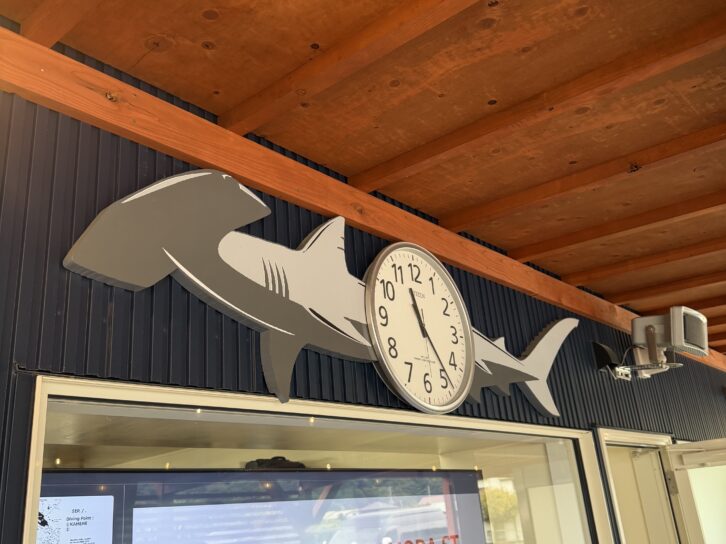
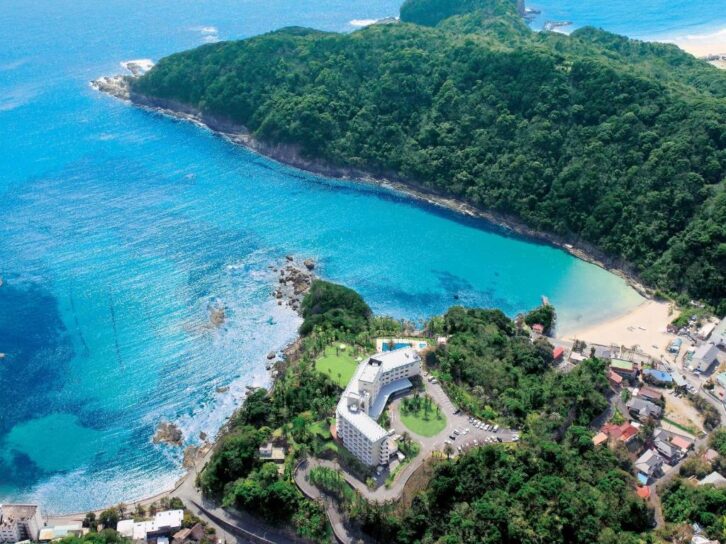
The day starts early. At 6:00 a.m., the Mikomoto Hammers van is already waiting in front of the hotel to pick us up. The sun is already up, so we’re standing in the daylight waiting for the van, which pulls up at the hotel entrance five minutes before the agreed-upon time. We’re staying at the lovely Tokyu Hotel, a beautiful hotel with a view of the bay. The hotel is also a partner of the dive school, which is why we’re being picked up here instead of at the station.
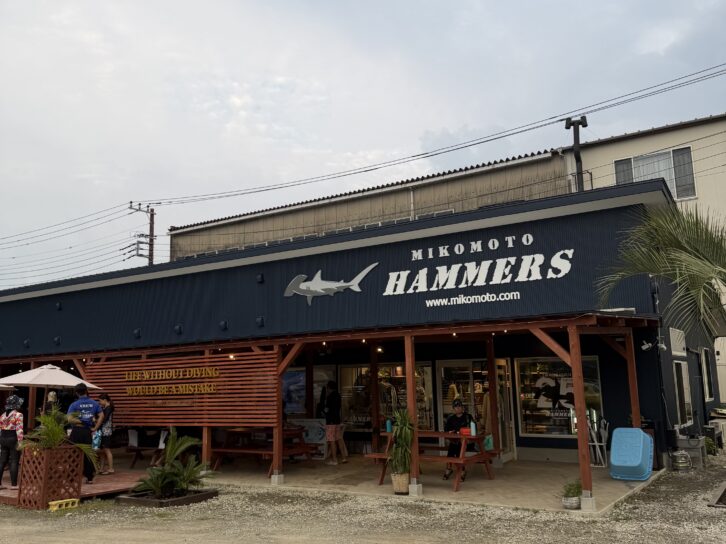
The dive shop operates very efficiently. On the van ride, we’re given the forms we need to fill out and sign. Then the briefing video starts, which we watch on the way. The ride to the dive shop takes about fifteen minutes.
The video mainly explains how the day will unfold: how we’ll get in and out of the water, what to do if we see sharks, and what to watch out for when there’s a current. The rules for interacting with sharks are clear: don’t swim after them, keep your distance, and respect the animals. It also explains what to do if you get caught in a downcurrent. It’s helpful to have this information in advance, although our dive guide will give us another briefing later on the specific dive sites.
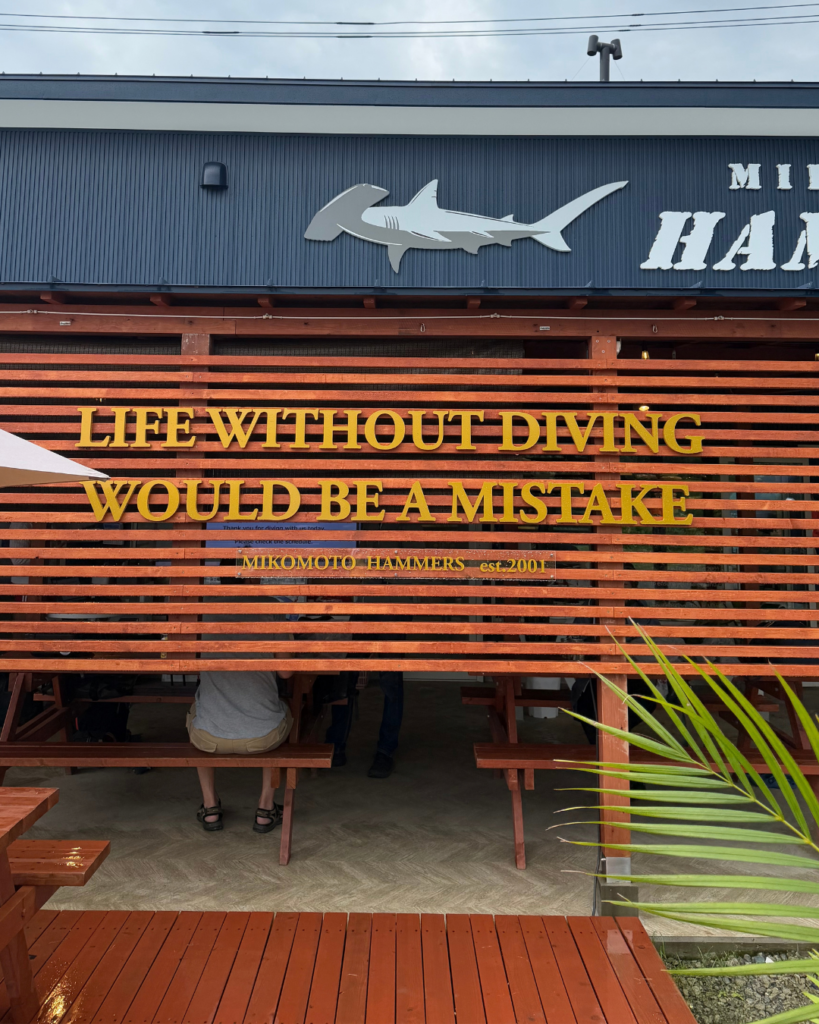
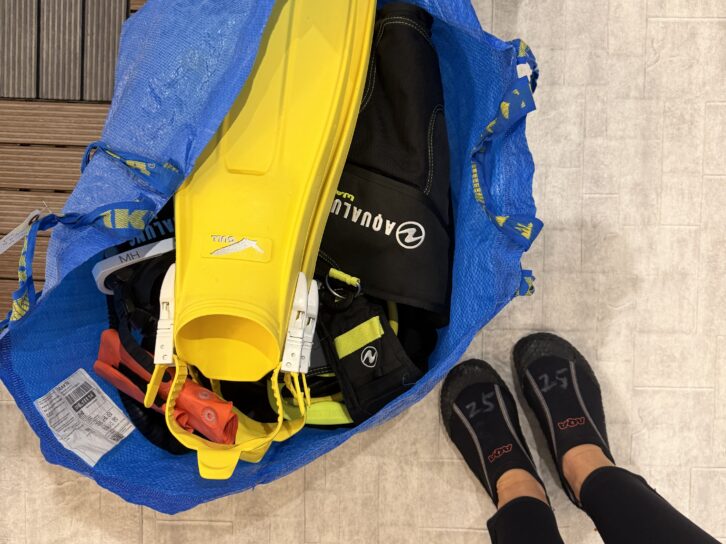
When we arrive, our rental gear is already waiting for us. In IKEA bags! I actually like that, because I use exactly the same kind of bag at home to toss my wet diving gear in the back of the car. Highly recommended, by the way: they’re dirt cheap, waterproof, and hold a surprising amount.
The rental equipment also includes a dive computer. It’s especially important here to keep a close eye on your depth, because there can be a downward current. I brought my own computer. I prefer it anyway, and besides, I need to set it up for nitrox. If you’re nitrox-certified, you can dive with nitrox here for free.
There are two spacious changing rooms where we can get changed. After that, we check our bags to make sure everything fits. We leave the bags in the changing room and walk toward the boat with our wetsuits half on and our dive shoes on.
On board: everything is well organized
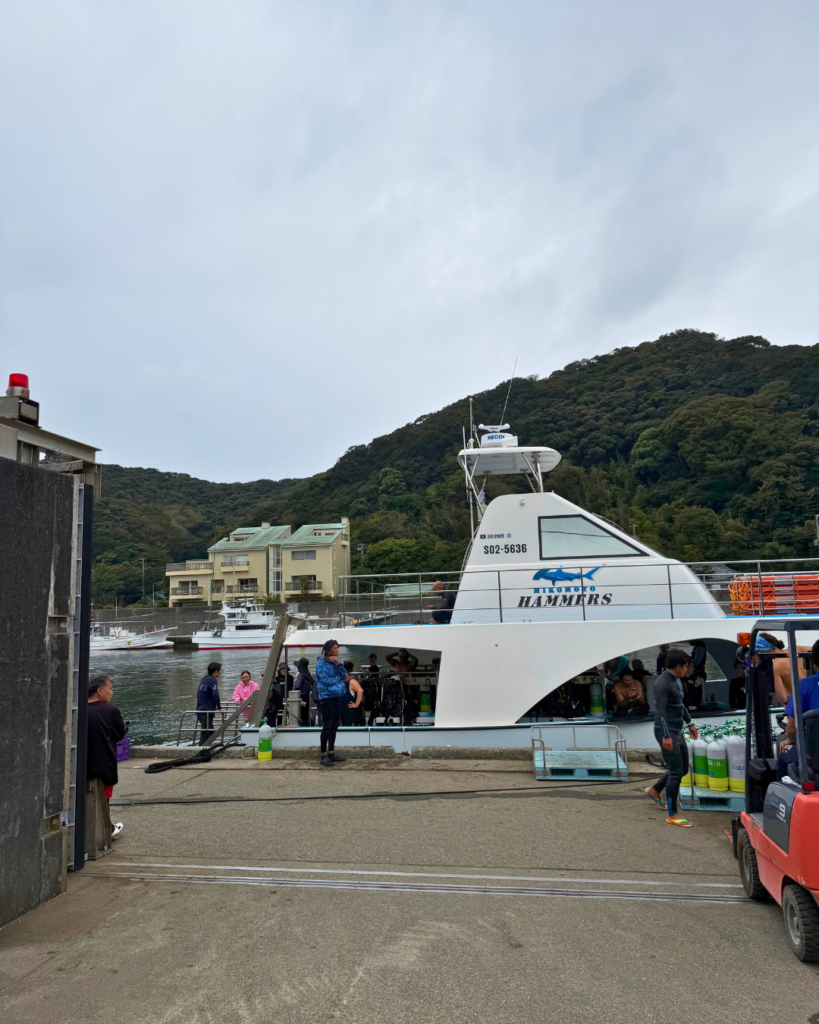
The boat leaves at 7:00 a.m. It’s just a short walk to the harbor, where the boat is already waiting. Our bags of diving gear are loaded into the back of a pickup truck and taken to the boat.
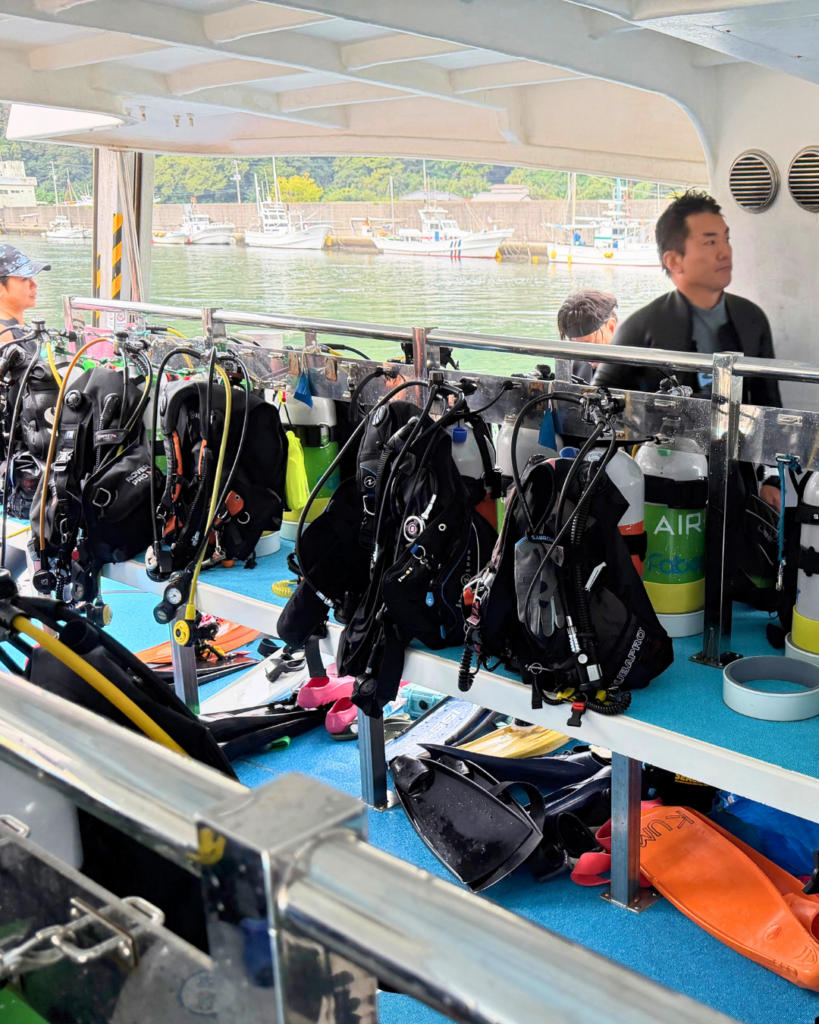
It’s peak season at Mikomoto, and the boat can carry up to fifty people. It’s pretty full this morning, too. To keep the different groups separate, everyone gets a colored wristband. That way, we can easily find our own group and guide. Each group has its own designated area on the boat to get their gear ready and enter the water.
The boat ride to the dive site takes about fifteen minutes. In the meantime, we get everything ready and check our gear. We also receive our weight belts. At the front of the boat is a dry area where you can leave your bag. There’s also a large water tank with reusable cups, and it’s clearly marked which cups are clean and which have been used. On both sides of the boat, there’s a restroom and a shower with hot water. That’s nice, especially after a day of diving at sea.
Our guide gives the briefing in English. Our group is quite international, with a Dutchman (myself), an Italian, a German, a Frenchman, and an American. The guide’s English isn’t perfect, but it’s good enough to understand the dive plan clearly. He also uses a map of Mikomoto Island so we can get a better idea of where we are and where we’ll be diving.
As soon as we’re almost at the location, we put on our weight belts and the rest of our gear. Each group heads to the back of the boat at the same time. As soon as the guide gives the signal, we take a giant stride and jump into the water while the boat continues on. So it’s important that you’re ready on time.
We wait until everyone is in the water and then descend as a group. The guide makes it very clear beforehand: we don’t dive in buddy pairs, but as a single team. If even one person wants to go back up or runs out of air, the whole group goes with them. This is because of the currents that can occur here.
The maximum dive time is also clear: 35 minutes, including the safety stop. You’ll be diving with a 10-liter tank, and if you have to swim hard against the current, that time frame isn’t all that surprising. Still, it feels short—after all, there’s only so much time to find sharks!
Two dives, but no large school of hammerhead sharks
Our first dive gets off to a calm start. We descend into the blue, but soon see the bottom. We start at a depth of about twelve meters. There’s no current, so we swim leisurely along the reef. Meanwhile, our eyes remain focused mainly on the blue. My strategy is to stay close to the guide. Maybe he’ll spot something I’d overlook on my own.
Unfortunately, visibility is poor. September is typhoon season in Japan, and a typhoon swept through the area the week before. I estimate that visibility is about five meters. The water is greenish, and it’s impossible to see very far.
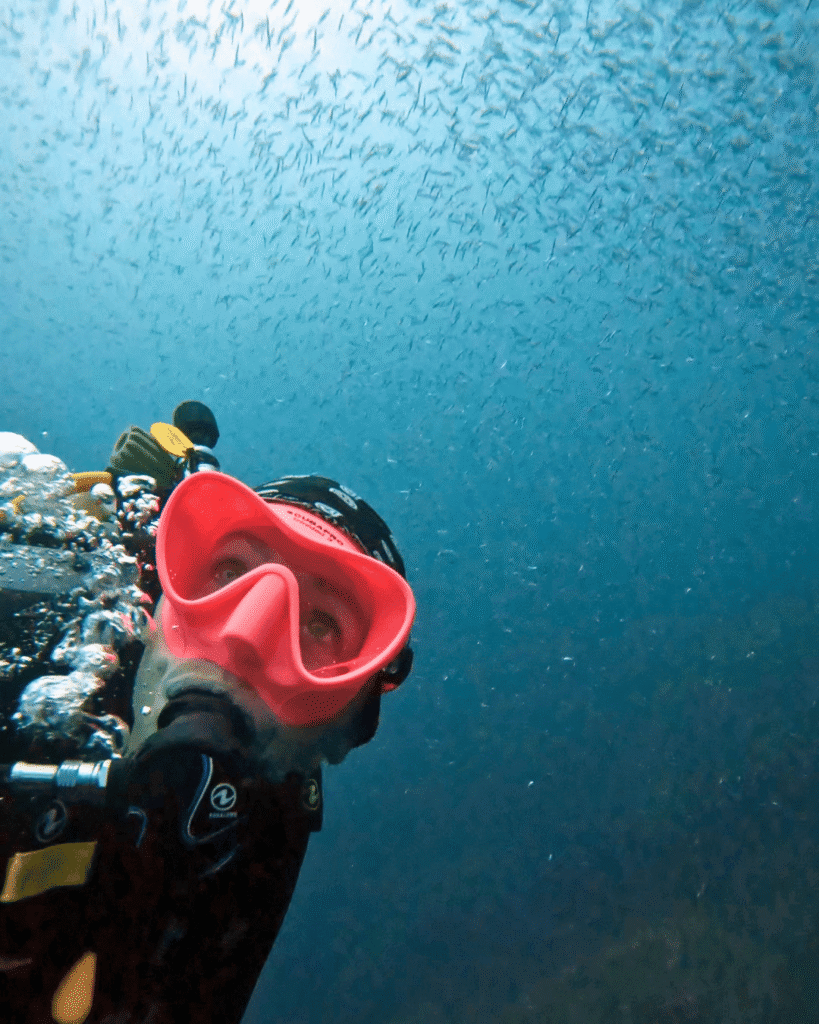
Still, there’s plenty of marine life. Huge schools of fish are swimming around, and if you look at the surface, you can see thousands of fish gathered together. After about ten minutes, a gray shark swims right past our dive guide. It disappears just as quickly as it appeared.
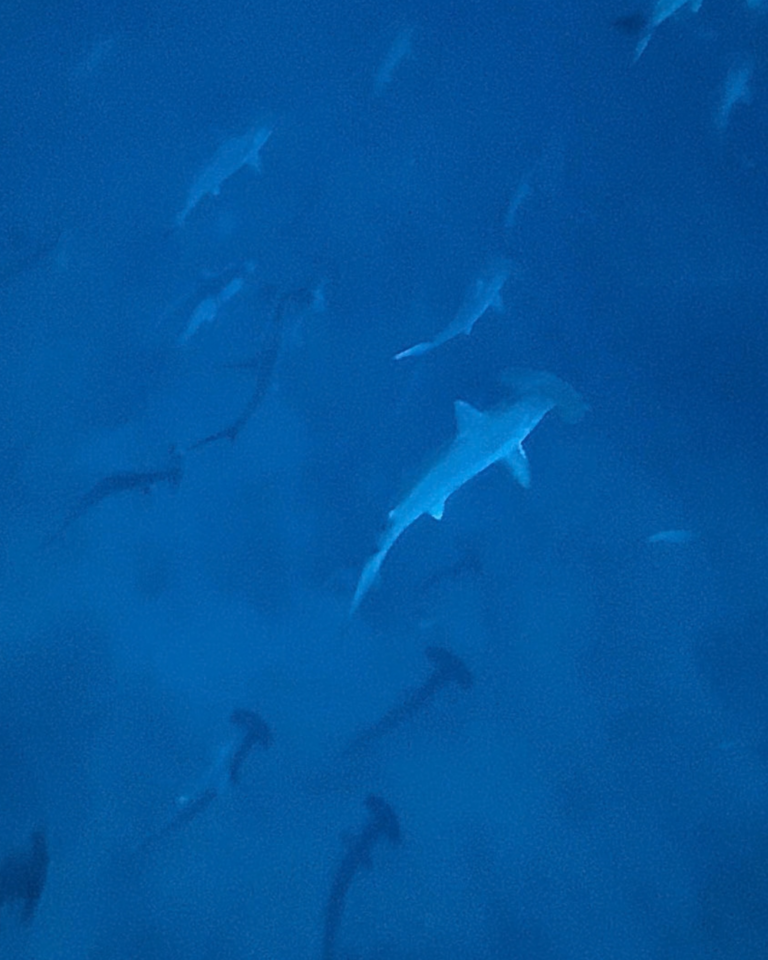
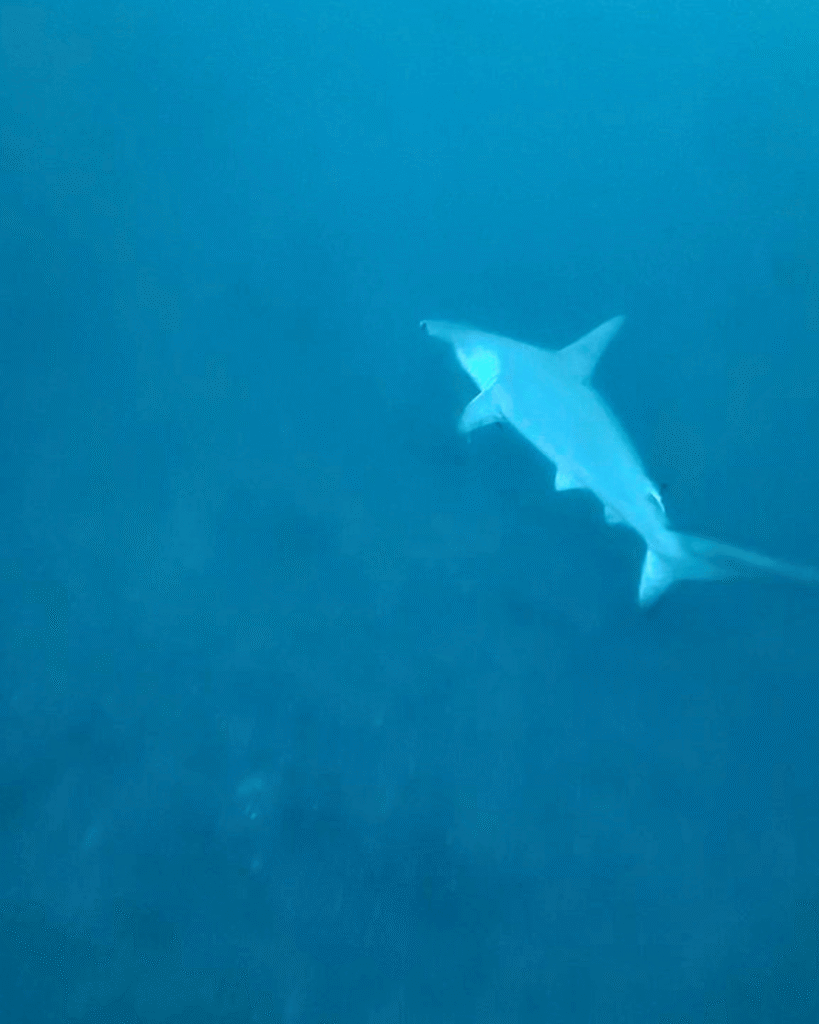
A little while later, we spot something in the blue in the distance: a hammerhead shark! Unfortunately, it stays at a distance, and the poor visibility makes it hard to get a good look at it. We also see a moray eel. After about thirty minutes, the guide signals for the safety stop. We make the stop in the blue water, after which the boat comes to pick us up.
The boat doesn’t drop anchor, so we’re picked up while it stays close to us. It’s incredibly well-organized. A lift is lowered into the water, and we board in groups. It’s ideal, especially with the waves. Each group surfaces at a different spot, so you have to swim toward the boat fairly quickly and step onto the ladder so you can be lowered onto the boat and the boat can move on to the next spot.
After the first dive, we return to the harbor, where the next tanks are already waiting for us. On the way back, the weather slowly begins to change. The wind picks up and it starts to drizzle a little. We prepare our new tanks and set out again. Since we make two trips of about fifteen minutes each, we’ve already completed a large part of our surface interval by the end of the crossing.
The sea has gotten a lot rougher by now, with higher waves. For the second dive, we’re heading to the other side of the island, where we’ll be looking for currents. Stronger currents can increase the chance of seeing sharks, though of course that’s no guarantee.
This dive is very different from the first one. There’s a strong current, and sometimes we have to hold on to the rocks. At other times, we drift along the wall. It’s hard work to maintain our position while also keeping a close eye on our surroundings.
Unfortunately, we didn’t have any luck spotting a large school of hammerhead sharks this time either. We did see two individual sharks, but they stayed at a distance. It’s nice to see them, but if you come to Mikomoto specifically to see the large schools, you naturally hope for more.
After the dive: warming up at the dive shop
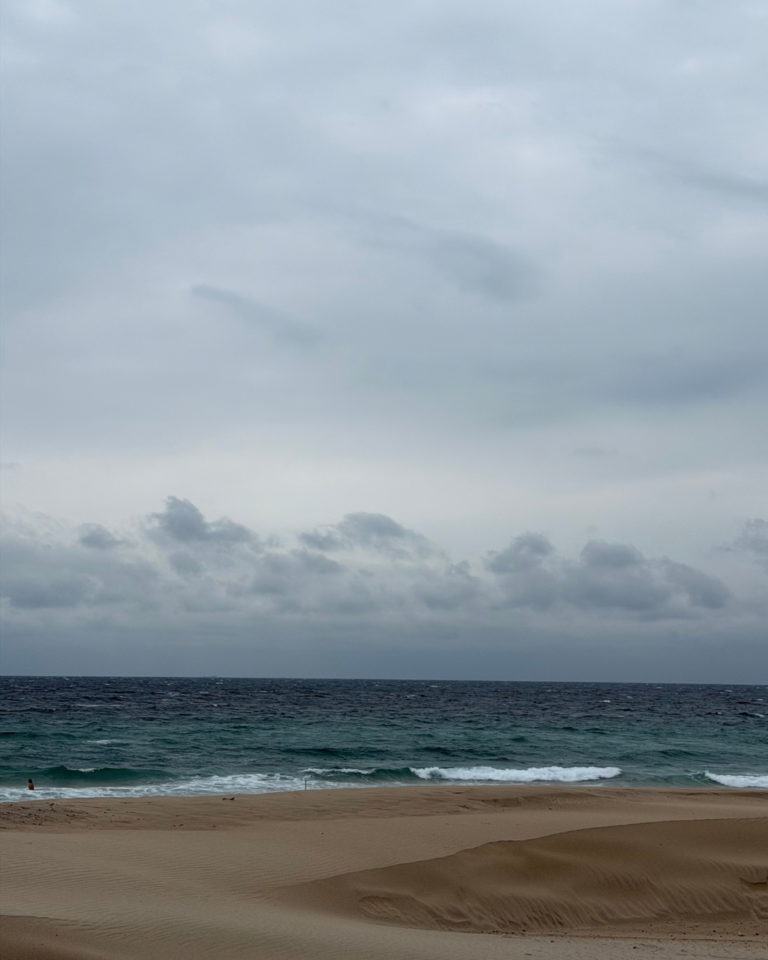
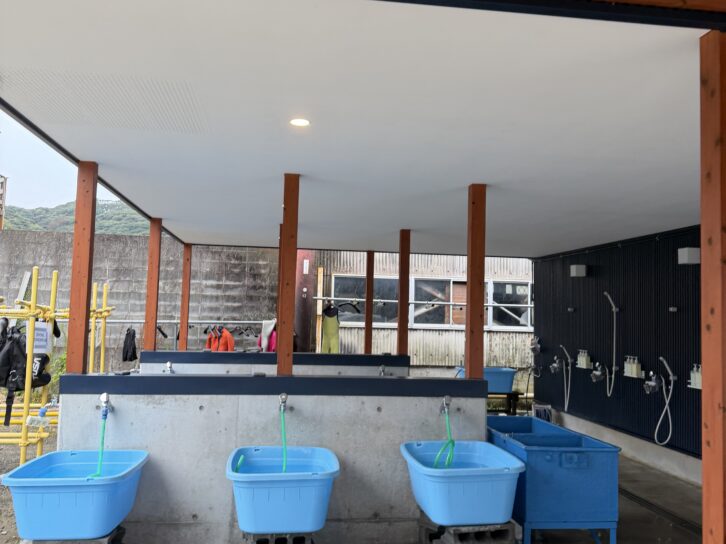
After the second dive, the wind had picked up even more. The water was about 24 degrees, so it wasn’t cold underwater. But with the waves, the wind, and the trip back to the harbor, we still got pretty chilled. Luckily, as soon as we arrived at the dive shop, we were able to take a hot shower right away.
The dive shop rinses off our gear for us. We just have to wash our wetsuits ourselves. Then it’s time to take a shower. There are plenty of hot showers, so we don’t have to wait. Soap, shampoo, and conditioner are also provided. You can rent a towel for a few euros, but of course you can also bring your own.
I discover my favorite amenity in the locker room: a spin dryer for swimwear! It lets you dry your swimsuit, rash guard, and even socks or a headband in just a few minutes. Perfect, because now I can pack them right into my suitcase.
After showering, we can grab some hot tea or coffee and log our dives. We still have to wait about half an hour for the ride back to the hotel, but that’s no problem at all. We’ve formed a nice little group of divers by now, and everyone has plenty of stories to share.
Is Mikomoto worth it?
Unfortunately, our mission to see a large school of hammerhead sharks was unsuccessful. We did see a few individual sharks, but the large schools remained out of sight. Another group on board had better luck. There were five different groups that day, and one of them did see a large school of hammerhead sharks. So they were there—just not when we happened to be in the right spot.
And in hindsight, we were a bit unlucky with the weather anyway. We had planned two more days of diving at Mikomoto, but unfortunately, those were canceled due to the weather conditions. As a result, we ended up with just this one day of diving.
That’s obviously a shame when you travel all the way to Japan specifically to dive here and hope to encounter large schools of hammerhead sharks. At the same time, that’s just part of diving with wild animals in a location where the weather and the sea play such a big role. You can’t plan for the conditions, and ultimately, safety comes first.
Mikomoto remains a special destination for experienced divers who want the chance to see hammerhead sharks. Keep in mind, however, that the current can be strong, visibility may be poor, and you may sometimes have to settle for a distant encounter. Unfortunately, we didn’t see the large school, and due to the weather, we couldn’t go back to try again. But of course, that doesn’t mean there isn’t a reason to go back someday.
Are you planning a trip to Japan, too?
Japan offers many opportunities for a diving trip. At Mikomoto, off the coast of the Izu Peninsula, you can dive with the chance to see large schools of hammerhead sharks. Be aware, however, of changing weather conditions and strong currents, which can affect both the dives and your itinerary.
In addition to Mikomoto, you can of course also explore Japan above water. During our tour, we explored various parts of the country. You can read more about that in our separate travel report. Would you prefer a diving trip to the tropical part of Japan? Okinawa, in southern Japan, also offers plenty of opportunities for diving. Check out our trips to Okinawa if you want to combine Japan with diving.




Combination trip Japan – Round trip & diving with hammerhead sharks at Mikomoto
In 2 weeks you will discover the best of Japan: from Kyoto’s ancient temples and the landscape around Mount Fuji...





Combination trip Japan – Tour & diving on tropical Okinawa
Discover Japan in three weeks full of adventure, culture and nature. Walk through bustling cities, historic villages and serene mountain...