Dive report: diving in the Blue Hole of Dahab
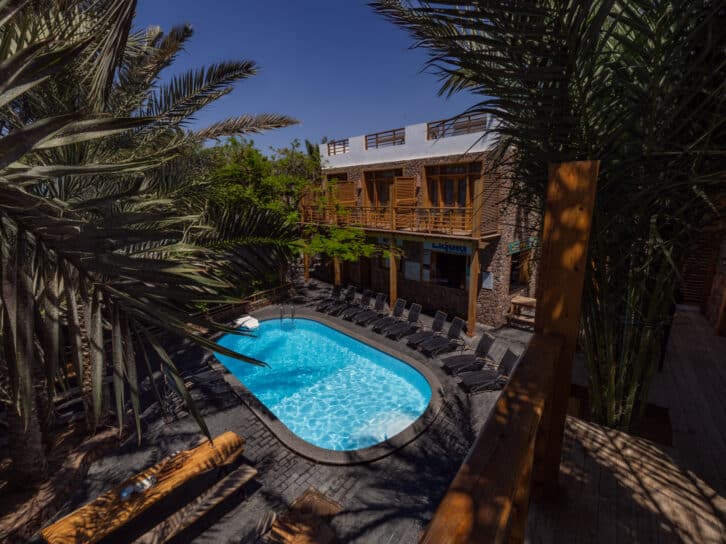
Dahab is the perfect base for a week of diving in Egypt. It is a lively village full of restaurants, is right on the sea and has good dive sites. Most of these dive sites are no more than 10 minutes from the hotel and diving school. The most famous dive site? That is probably the Blue Hole. Read Margriet’s dive report to this spot here.



Margriet works at EWDR as a marketing and content specialist. She is also an avid diver and diving instructor. Earlier this year, she spent a week diving in Dahab, one of Egypt’s best diving destinations. In this report, she takes you through her experience while diving in Dahab’s famous Blue Hole.
Dahab’s Blue Hole is one of the most famous dive sites in the world. The place owes this not only to its beauty, but also to its reputation. And that is not always positive. Anyone who googles the Blue Hole quickly comes across the nickname “the divers cemetery.” That name has mostly to do with the fact that the Blue Hole attracts many tech divers and freedivers who want to break their personal depth records here. The Blue Hole itself is more than 100 meters deep and contains a natural passage, the famous “Arch,” at about 52 meters deep, which opens into the open sea. These are depths and routes intended exclusively for experienced, technically trained divers and thus far beyond the reach of recreational diving.
But if you do a recreational dive here, stay within your own training and limits, and follow a good dive plan, there is nothing to worry about. Then it is simply a wonderful dive, just like so many other dives worldwide.
I’ve dived the Blue Hole of Gozo (Malta) before, but it really doesn’t compare to Dahab. The Blue Hole on Gozo is only 15 meters deep; you can see the bottom directly from the surface. The Blue Hole of Dahab is totally different and feels very different underwater as well.
Of all the dive sites, the Blue Hole is farthest from Dahab and from our hotel the Bridge is about a 30-minute drive. We go to all dive sites in Dahab by pickup; most are only a five-minute drive away. For us, the Blue Hole is the second dive site of the day. We start with a relaxing dive at Tiger House: a quiet dive site with lots of coral and reef fish.
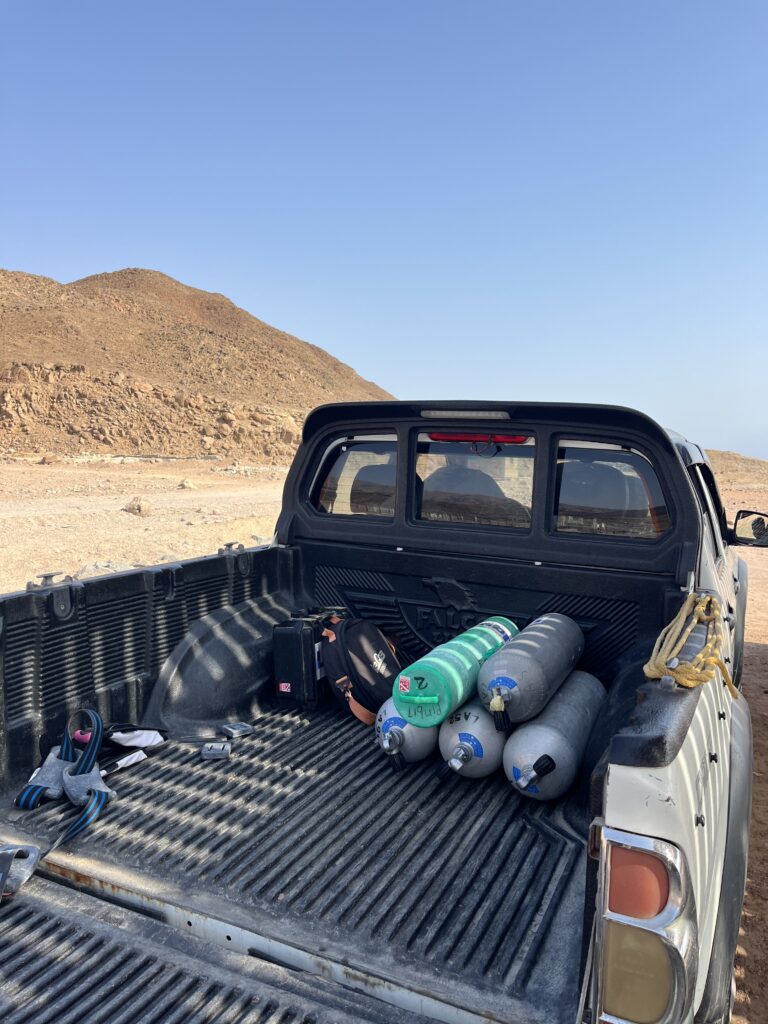
After the dive, we put our equipment in the back of the pickup. We ourselves sit there too, with wet wetsuits we are not welcome in the car itself for a while. But it is a short ride of a few minutes and before we know it we are already at the Blue Hole.
Whereas at most dive sites around Dahab it is wonderfully quiet, here it is markedly different. There are several restaurants, buses with tourists from Sharm el Sheikh and many snorkelers. In the water, you can immediately see where the Blue Hole is: not only because of the deep blue color of the water, but also because there are many freedivers training near the edge. There is a jetty with stairs into the water, making it easy to get in and out. We did not walk up to see the view of the Blue Hole ourselves, as shown in the photo below.


We stop at a restaurant, put a tarp on the ground and unload our gear. Here we can change tanks and re-prepare everything, then park the car a little further down the road. For our surface interval, we take a seat in one of the restaurants.
It’s January, so it’s a bit cooler by Egyptian standards: about 25°C air temperature and 24°C water temperature. Fortunately, in the sun with a hot tea you warm up quickly. We order lunch in advance for after the dive and also do the briefing here. On the tables are maps of the dive site, ideal.
As we go to get ready for the second dive, Smily, our dive guide, tells us that we can just leave our stuff in the restaurant. Bag, phone, money – everything. He does it himself and assures us that nothing will happen. It feels strange for a moment, but we trust Smily. We will come back here anyway, he says. Also to pay, because we don’t have to pay for our coffee and tea yet either.

Our dive plan is as follows: we start at The Bells. This is a narrow, vertical shaft (called a chimney) in which you descend from the surface to depth all at once. It feels a bit like being in an elevator. There are openings in the chimney; at 26 meters and at 32 meters you can get out towards the wall. Through the wall we then go to the Blue Hole, where we end the dive.
From the restaurant, we walk to the entry point in a few minutes. It is crowded here, especially with snorkelers who don’t always know how to enter the water with fins and snorkels. Fortunately, we can enter the water just ahead of a group. The stretch of water between the rocks on the surface is small, so we are glad to be underwater before someone accidentally kicks us.
The first part of the dive is really fantastic. The visibility is insane and we descend gently through the chimney. Before we know it, we are at 32 meters and following the wall towards the Blue Hole. Especially for my buddy, who has not dived much in an environment like this before, it is a super experience between the rocks. The view along the wall is impressive. Looking up from about 20 meters, I see the snorkelers as in a big clump together at the surface. For them there is probably not much to see along the wall, because they only look at us and they wave enthusiastically when they see me looking back.
Along the wall is plenty of life: reef fish, clown fish, trumpet fish and more. We slowly go shallower and it gets lighter and lighter. At about 7 meters, we reach The Saddle, a notch in the wall through which we can swim into the Blue Hole. Inside, we stay at a maximum of 12 meters and follow the wall toward our exit point.
It is bizarre to look below you and see SO much blue. I have made many dives in blue, for example during shark dives or at home in Sicily at deep where we have to navigate to the field of gorgonians, but this blue is different. Endless, perhaps. Perhaps it’s also that you know the bottom is not at 40 meters, but at hundreds. I can well imagine that if you are not sharp on your depth gauge and the pressure on your ears, you could go deeper than planned unnoticed. However, we have no intention of going deep again and swim along the wall toward the exit point.
We make our safety stop in the Blue Hole and after about 50 minutes we exit the water. What an incredibly beautiful and relaxing dive. And really: nothing to worry about. As always: stay within your own training and limits, make sure you have the right lead (not too much, not too little) and stick to the agreed dive plan. These are basic rules that always apply, and so here too. But are you nervous before a dive? Express that to your buddy and divemaster.
For us it was a successful dive and I am already looking forward to going back in November with my group trip.
Would you also like to dive the Blue Hole of Dahab? We offer year-round trips to Dahab. The high season is in spring and autumn, when temperatures are pleasant, but actually you can dive well here all year round. In winter, the water temperature is around 24°C and the air temperature is between 22 and 26°C.
Will you join us on a group trip to Dahab? Fun! We will dive with a group of up to 10 divers for a week on the most beautiful dive sites around Dahab, including the Blue Hole. Check out the itinerary and dates here.




Group Trip • Diving in Dahab: Blue Hole, Canyon & Ras Mohamed (SOLD OUT)
Join our group trip to Dahab, Egypt. A week of diving in the best spots of Dahab and surroundings with...
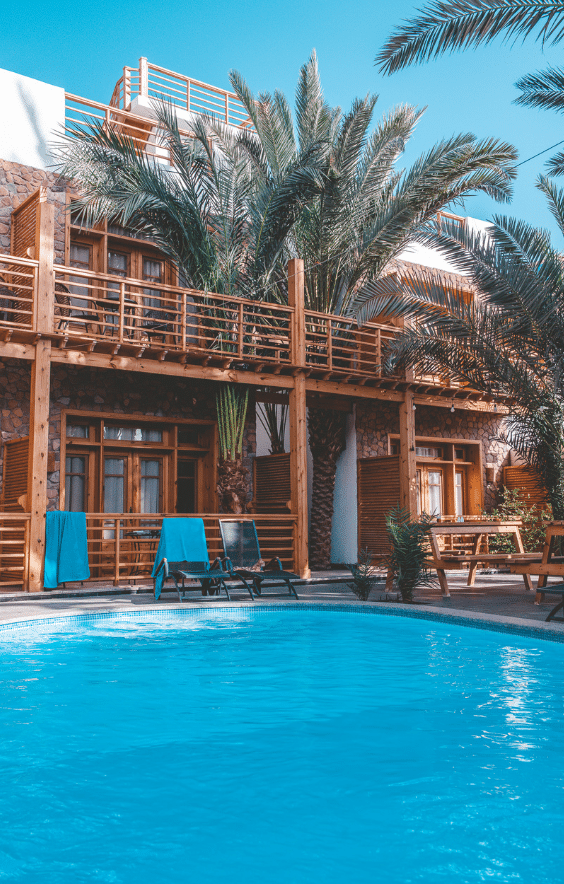

The Bridge Dahab – Diving at the Blue Hole & Thistlegorm
Stay at the Bridge Hotel in Dahab and enjoy diving around Dahab’s popular dive sites, including the Blue Hole and...