Travel Report: Diving with Mantas on Nusa Penida
During our trip through Bali, we decided not to visit Nusa Penida merely as a day trip. We wanted to see the island and dive there, so we stayed overnight. That turned out to be an excellent choice. On our arrival day, we had plenty of time to explore part of the island, and the following morning we could get into the water early. In this blog, I will tell you all about our dive with the mantas!
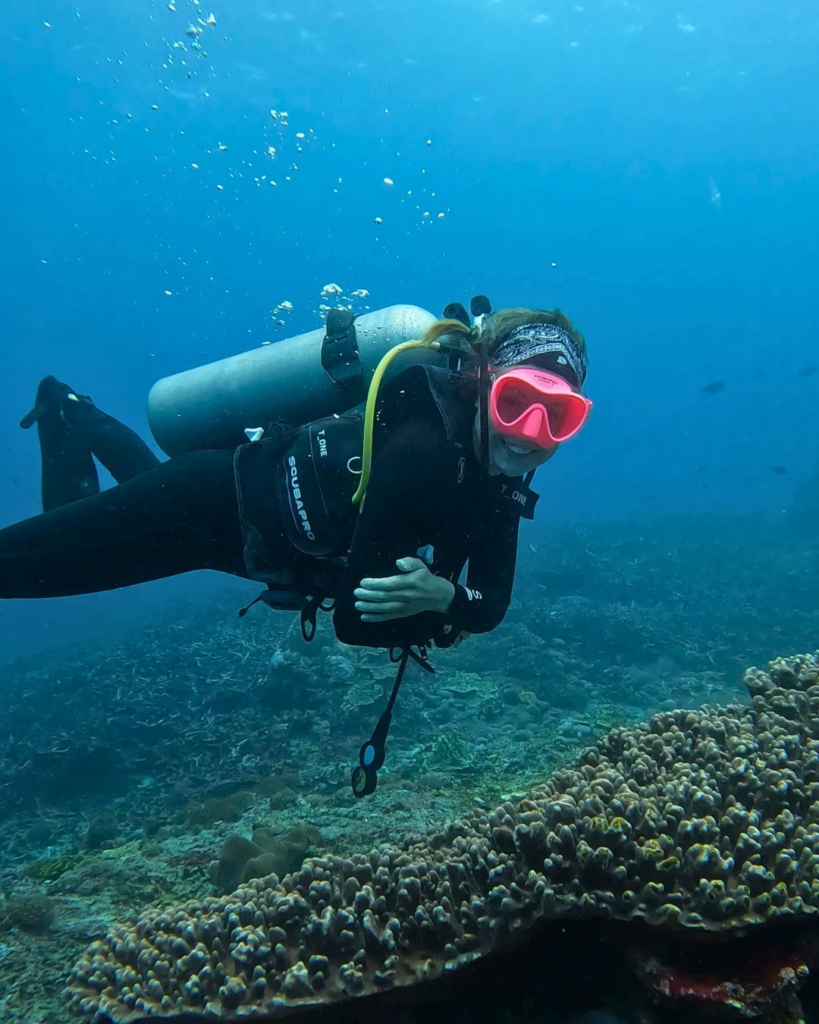

Margriet works at EWDR as a marketing and content specialist. Additionally, she is an avid diver and dive instructor who enjoys traveling to destinations with beautiful dive sites. In this travel report, she takes you along during her diving day on Nusa Penida—from the first mantas she spotted from the shore to the dives at Manta Point and Crystal Bay.
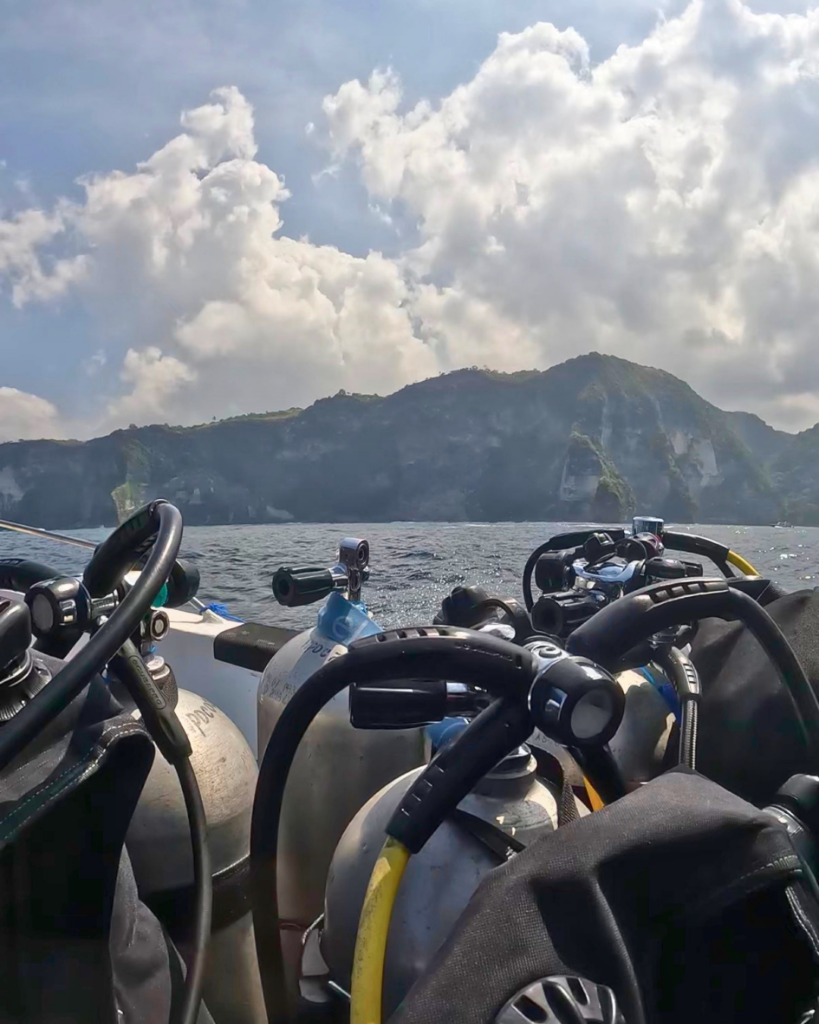
Our alarm goes off at 07:00; time to head to the dive center and prepare for a day of diving! From the dive center, it is over a 30-minute boat ride to Manta Point, and the sea was quite rough. We bounced across the water in the boat. Fortunately, all the scuba tanks are securely fastened in the boat, so there is no need to worry about that. Meanwhile, having a conversation was impossible. Due to the noise, speed, and bouncing, you simply could not hear each other anymore.
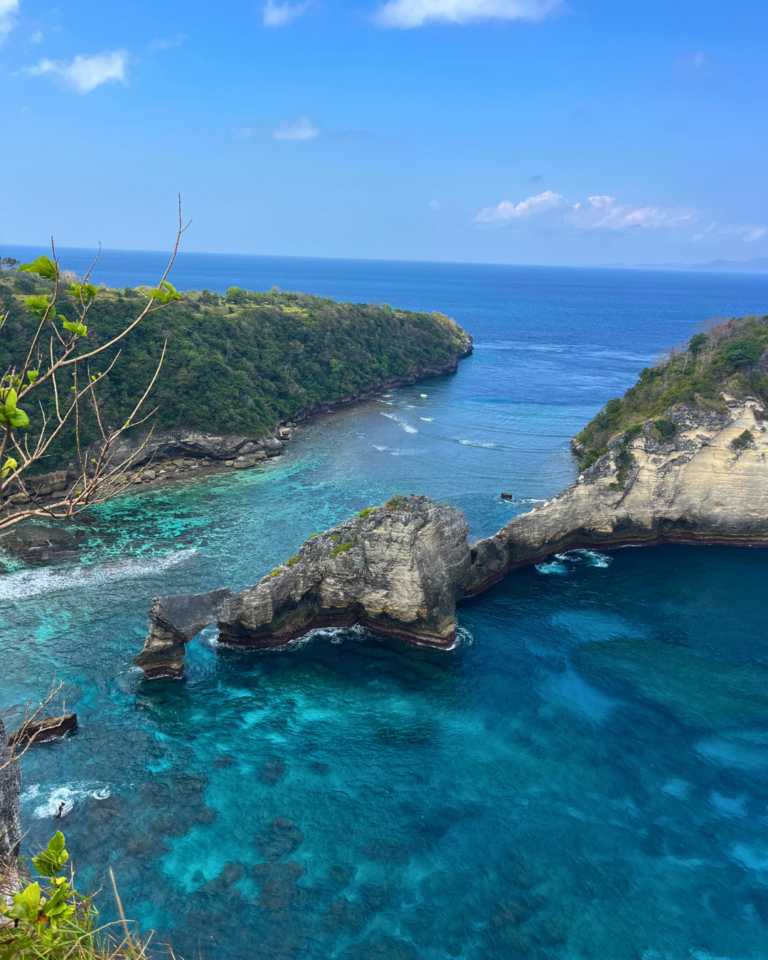
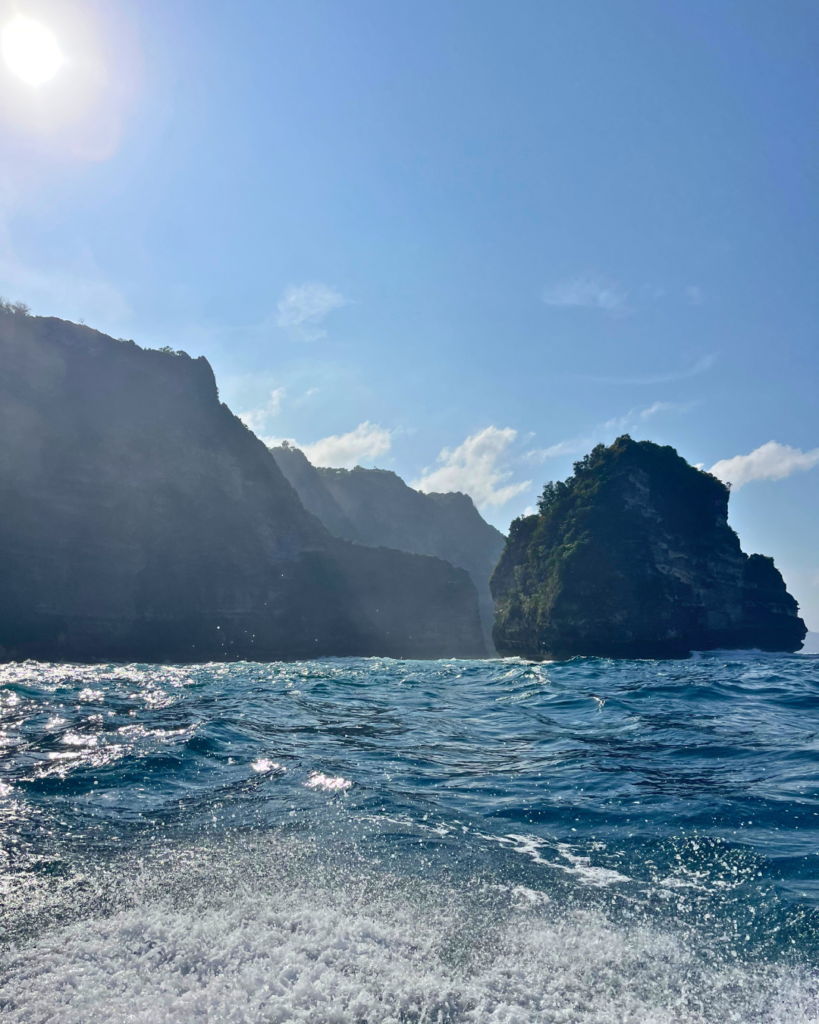
Nevertheless, the journey was beautiful. The coastline of Nusa Penida is rugged and impressive, and along the way, we passed Kelingking Beach, among other spots. From the sea, the famous rock formation looks completely different. At the time, there was still a massive crane there, intended for the construction of a lift. Fortunately, that plan has since been abandoned.
Upon arriving at Manta Point, we prepared to enter the water. The boat was quite full, but fortunately, the dive groups themselves were small. There were four of us plus a dive instructor.
The briefing was actually very straightforward. We would go to a specific point and wait there. If we didn’t see any mantas within twenty minutes, we would continue with the dive and start swimming. As soon as we entered the water, we noticed how strong the surge was. You were literally pulled back and forth by several meters. This made it difficult to stay in the same spot. The visibility was also not great. There was a lot of plankton in the water, resulting in about six meters of visibility.
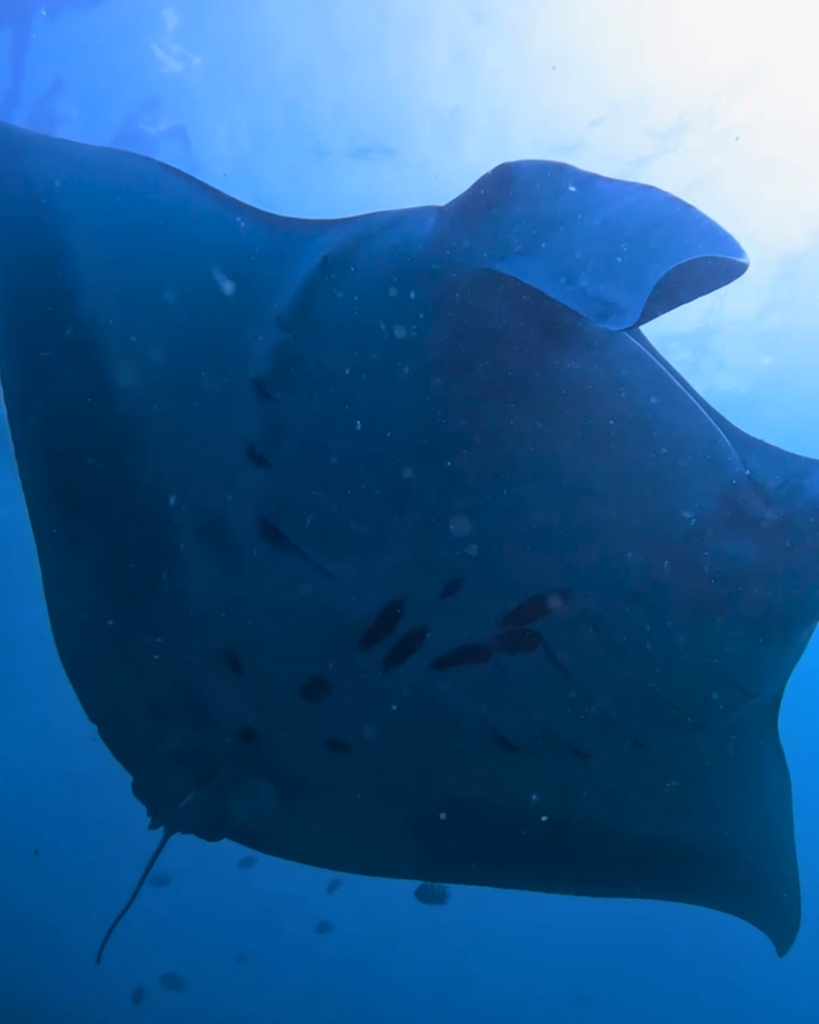
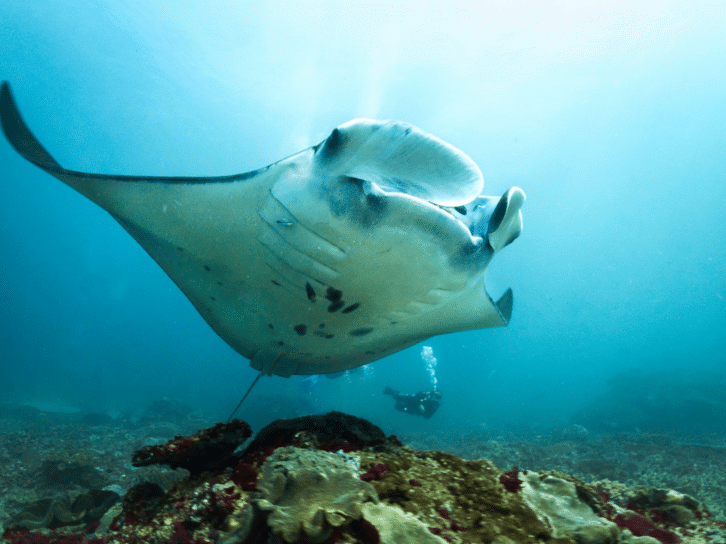
The two other divers in our group were still quite inexperienced and clearly struggled with the conditions. Meanwhile, I was mainly curious about when the first manta would appear. After about ten minutes, we suddenly heard loud tapping on a scuba tank. The first manta! Due to the limited visibility, it seemed to appear out of nowhere. The manta glided calmly through our bubbles. A moment later, we heard tapping again, but this time further away. Another group had spotted the same manta. Then I turned around and suddenly stood eye to eye with another manta. From that moment on, they seemed to be everywhere. They passed by calmly and did not seem to mind the divers’ bubbles at all. In fact, it sometimes seemed as if they intentionally swam through them—a kind of spa for mantas. And although poor visibility is normally not something to be happy about, it had a certain charm here. You never knew what would emerge from the plankton a few meters ahead of you. Suddenly, there was another one of those enormous mantas.
Finally Seeing Mantas
I had completed hundreds of dives worldwide by then, but I had never seen a manta. That made this dive extra special. It was not just a beautiful dive site, but truly a remarkable encounter! At one point, our divemaster indicated that we were leaving the cleaning spot to begin the rest of the dive. We had to swim on, leaving the place where we had waited for the mantas. To be honest, I could have stayed there quite a bit longer. The mantas kept coming, and I wouldn’t have minded hanging in the same spot for another twenty minutes.
The dive itself was also enjoyable, but due to the strong surge and limited visibility, it was difficult to swim steadily and take photos. Therefore, I mainly filmed this dive with my GoPro. Along the way, we encountered a large group of cuttlefish. Always a pleasure, as they are definitely among my favorite animals. I was completely distracted by the cuttlefish for a moment until the divemaster pulled my fin. I had to turn around. A black manta was coming straight toward us!
During our safety stop, we received one last surprise. An enormous manta appeared out of nowhere beneath us. Those are the moments when you actually want to descend again, even though you know it is not a good idea.
Manta Point Gets Crowded Quickly
Once we surfaced, we immediately saw how much busier it had become. We were one of the first boats at Manta Point, but by now there were quite a few boats and many snorkelers in the water. The sea was still quite rough. Personally, it did not seem like an ideal spot for snorkeling, but apparently, that did not stop many people. It was an immediate illustration of why it pays to head out early. Manta Point is one of the most famous spots on Nusa Penida for a reason, and it can get quite crowded.
Diving at Crystal Bay
After Manta Point, we proceeded to our second dive: Crystal Bay. This dive site is primarily known as a place where you have a chance to see mola mola, or sunfish. Actually, I knew beforehand that the chance for us was slim. I was diving in the Open Water group that day, and our maximum depth was 18 meters. My boyfriend did not have his Advanced Open Water certification yet, and we also found it much more enjoyable to dive together than for one of us to join the deeper group alone. In hindsight, that turned out to be excellent motivation to finally get that Advanced certification. Incidentally, the group that could go deeper did not see a mola mola either. That made the missed opportunity feel much less disappointing.
Crystal Bay owes its name to its clear water. Under good conditions, the visibility here can be so good that you almost forget you are underwater. Today, unfortunately, was different. In the bay, above the sandy bottom, the visibility was quite poor—a bit like diving in the Vinkeveense Plassen. Fortunately, it improved as we went deeper. We saw several turtles and other fish, but it was particularly striking how busy it was underwater. Divers were visible everywhere. So, no mola mola, but after the mantas that morning, we couldn’t really complain.
Back to Bali
After the second dive, we returned to the dive center. A delicious plate of nasi was waiting for us there. We had lunch with our new dive buddies and were able to chat quietly about the dives. There were also a few dogs wandering around the dive center, and there was a nice, relaxed atmosphere. We were able to shower there before packing our things and heading back toward the harbor.
Time to leave Nusa Penida behind and return to Bali.
For me, Manta Point was especially a dive to remember. Not just because I finally saw my first mantas, but precisely because of the conditions. The poor visibility, the strong surge, and the mantas constantly appearing unexpectedly from the plankton made the encounter extra special. And after hundreds of dives, finally standing eye to eye with my first manta? Even a bit of rough water couldn’t change that.
Also experience this diving trip?
We offer several dive trips to Bali, fully customized. Like us, do you want a trip that differs from what’s on the website? No problem, anything is possible!




14-day diving trip Bali – Nusa Penida & Tulamben
A varied Bali diving trip with 2 dive sites, including the spectacular Nusa Penida and the iconic Tulamben. Meet manta...




Best of Bali – 3 week round trip
Discover the best of Bali both above and below the water. During this varied 3-week round trip you will dive...