Diving in Jordan: a complete guide
In Jordan, diving is done in Aqaba, the only port city the country has. This city is located on the Red Sea and has unimaginably many dive sites. For example, did you know that there is a military underwater museum? There you dive among tanks, armored vehicles, a helicopter and even an anti-tank gun. Everything is deliberately sunken to encourage coral growth as well as to offer divers a unique experience. You’ll also find the wreck of a plane: the C-130 Hercules plane wreck.
Diving in Jordan tends to be incredibly relaxed. The water is calm year-round, the visibility is good and the diving schools have adopted that calm pace as well. Stay on the water all day, have lunch on board, relax between dives. Everything is taken care of. The atmosphere is friendly, the instructors are professional and the underwater world is surprisingly rich.
Whether you love colorful reefs, wrecks or just a relaxing day of diving under the sun, Aqaba has it all. And the best part? You share most of the dive sites with only a handful of other divers. Jordan really is still a hidden gem in that respect.
Table of contents
General information about Jordan
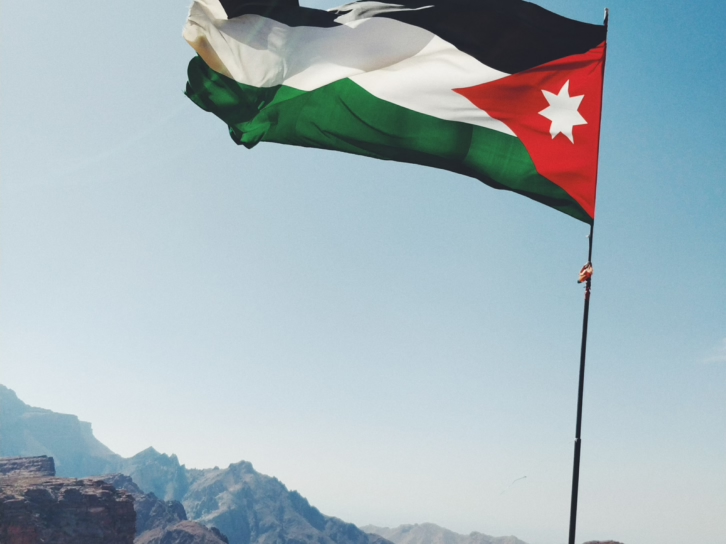
Jordan is located in the Middle East and borders Israel, Saudi Arabia, Iraq and Syria. The country has only a small stretch of coastline near the city of Aqaba. The rest of the country consists of desert landscapes, mountains, ruins and special natural areas. You dive into the Red Sea here.
What makes Jordan so unique is its mix of impressive history, welcoming culture and surprising natural beauty. You will find world-famous sites such as:
- Petra, the ancient city partly carved out of the rock. This is 1 of the 7 wonders of the world.
- Wadi Rum, a vast desert full of rock formations where you imagine yourself in another world. Films such as The Martian and Dune have also been shot here.
- The Dead Sea, the lowest point on earth, where you float effortlessly thanks to its high salt content.
Despite being a desert country, Jordan feels surprisingly green and alive in some parts. Especially in the north, you’ll see orchards, olive trees and even waterfalls. And then you have the Jordanians themselves: warm, friendly and always willing to help you or offer you a cup of tea.
What makes traveling in Jordan extra nice: it is conveniently arranged and well organized. Distances are relatively short, tourism is developed but not massive and you can effortlessly combine culture, nature and diving adventure.


Why dive in Jordan?
Diving in Jordan feels a bit like a well-kept secret. You dive here in the Red Sea, near Aqaba, where the water is clear, warm and remarkably calm. Virtually year-round, you have good visibility and hardly any current, making dives here quite relaxing.
What makes it really special here are the unique dive sites. In fact, Jordan has gone big with artificial reefs. Think of a complete military underwater museum with tanks, jeeps, a helicopter and even an anti-aircraft gun. Everything has been deliberately sunk at dive-friendly depths, so you can get a good look at it while giving marine life a chance to make it a new home. You literally swim among war materials and colorful coral here, making it surreal and fascinating.
You will also find the wreck of a C-130 Hercules transport plane, at a depth of about 15 to 17 meters. The cockpit, the cargo hold, everything is accessible and overgrown with soft coral. There are also other wrecks, such as the Cedar Pride, a classic cargo ship beautifully overgrown and often visited by schools of fish.
In terms of marine life, there is more to see than you might expect. Among the coral live plenty of reef fish, morays, coral crayfish, scorpion fish and regularly turtles. If you’re lucky, you’ll see an eagle ray float by. Octopuses, barracudas and even dolphins are also occasionally spotted.
The nice thing is: you don’t have to go deep or look far. Many of the most beautiful dive sites are right off the coast and are easily accessible both from shore and by boat. Whether you are just beginning to dive or have years of experience, Aqaba offers a relaxed and surprisingly diverse underwater world that you won’t soon forget.
Best travel time for diving in Jordan
You can dive well all year round in Jordan, but the very best travel time is during the months of March, April, May, September, October and November. During these periods, the temperature above and below the water is most comfortable. The air is warm but not too hot, the water is between 23 and 27 degrees and visibility is excellent. Ideal for relaxed diving in the Red Sea near Aqaba.
During the summer months of July and August, it can get quite hot above water, with temperatures exceeding 40 degrees. Underwater is still fine, but on the boat or between dives it does get very hot. Many dive schools therefore schedule dives early in the morning during this period.
In the winter months of December, January and February, the water temperature drops to about 20 degrees. Still doable with a thicker wetsuit. Visibility remains good, and with a little luck you’ll also see larger sea dwellers during this period.
- Visibility: Underwater visibility in Jordan is generally excellent. In most cases, you can expect visibility between 20 and 30 meters, depending on weather conditions and the season. The best conditions are in spring and fall, when the water is clearer. When diving in the summer months, visibility may be slightly less due to the heat in the water column, but in general it always remains good.
- Water temperature: Water temperature is pleasant throughout the year. In the summer months, the temperature is between 27 and 29°C. In the winter months it is slightly colder: around 20°C. So you can dive here in a 3 mm wetsuit in the summer months just fine, but in the winter months it is better to bring at least a 5 mm wetsuit.
- Currents: In Aqaba and surrounding dive sites, there is usually no or little current. This makes diving here particularly relaxed and ideal for both novice and experienced divers.
| Period | Diving conditions | Wetsuit Advice | Details |
|---|---|---|---|
| March – May | Best visibility (20-30 m), calm sea, warm water | 3-5 mm | Ideal time for diving, pleasant temperatures |
| June – August | Warm water (26-28°C), calm sea, reduced visibility possible | 3 mm | Very warm above water, diving possible, start early |
| September – November | Very good visibility, calm sea, warm water | 3-5 mm | Top months for diving, perfect conditions |
| December – February | Colder water (20-21°C), calm but reduced visibility possible | 5 mm | Calm, colder water, fewer tourists |
What kind of diving do you do in Jordan?
Diving in Jordan is varied. You’ll find more than 20 dive sites along Aqaba’s coastline, with a nice mix of shore diving and boat diving. Many sites are accessible directly from the beach: you walk into the water, swim out a bit and you’re already there. Daily boat trips are also organized where you combine several dive sites in a relaxed way, including lunch on board.
What makes Jordan truly special is the amount of wrecks. From the famous Cedar Pride freighter to the C-130 Hercules aircraft to the unique underwater military museum with tanks, jeeps and a helicopter, all artificially sunk and now transformed into thriving reefs.
The marine life is mostly small but colorful. You won’t dive with sharks or manta rays here, but you will be among schools of reef fish, coral butterflies, puffer fish, moray eels and the occasional turtle. Perfect for those who enjoy relaxed diving, macro photography or just floating around among beautiful coral.
Jordan is suitable for divers of all levels. Beginners can safely make their first dives here thanks to the calm waters and good visibility. Advanced divers enjoy the wrecks, reef life and variety. There are also options for tec divers: some wrecks are a bit deeper, and there are diving schools that offer technical diving and training.
Best dive sites in Jordan
Jordan may only have a small stretch of coastline, but the dive sites at Aqaba are surprisingly diverse. You’ll find a unique mix of colorful reefs, unusual wrecks and even a military underwater museum. There are around 20 dive sites in Aqaba, so you can do many different dives here. In this overview, we take you through Jordan’s best dive sites.
C-130 Hercules plane wreck
C-130 Hercules plane wreck
Depth: 12-17 meters
Season: Throughout the year
Marine life: Puffer fish, crocodile fish, schools of reef fish, moray eels
Level: For both novice and advanced divers.
The C-130 Hercules is one of the most iconic artificial wrecks in Aqaba. This military transport plane was deliberately sunk in 2017 by the Jordanian government as part of their underwater military museum. The wreck lies on a sandy bottom at a depth of about 15 meters, with the wings and fuselage beautifully visible from the moment you descend. The cockpit is intact and easy to view,and you can even dive into parts of the wreck.
Because it is relatively shallow, this is a great dive site for all skill levels. The wreck attracts a lot of marine life, from puffer fish and crocodile fish to colorful reef fish hiding among the metal parts. The combination of good visibility, calm water and a special story make this dive a must if you are in Jordan. It almost feels like you’ve landed in a scene from a movie, but underwater.
TriStar Lockheed L1011
TriStar Lockheed L1011
Depth: 18-28 meters
Season: Year-round
Marine life: Reef fish, moray eels, coral colonies, sometimes octopus
Level: Suitable for both beginner and advanced divers
The Tristar is an impressive plane wreck that was deliberately sunk off the coast of Aqaba in 2019. It is a Lockheed L-1011-500 TriStar, an old passenger plane with room for about 300 people. Now the aircraft rests on a sandy seabed just off South Beach, at a depth of 18 to 28 meters. With a length and wing span of a whopping 50 meters, this wreck is nothing short of spectacular to behold. During your dive, you can float along the hull and wings, glimpse inside the cockpit or cargo hold, and enjoy the marine life that has now settled around the wreck. The Tristar is part of Jordan’s unique underwater military museum and a must-do for wreck lovers.
Cedar pride wreck
Cedar pride wreck
Depth: 10-27 meters
Season: Throughout the year
Marine life: Turtles, barracudas, scorpion fish, lion fish, lobsters (night dive)
Level: For both beginner and advanced divers
The Cedar Pride wreck is undoubtedly Jordan’s most famous wreck. In 1985, this former Lebanese freighter was deliberately sunk on the initiative of King Abdullah II to serve as an artificial reef. It now lies beautifully on its side between two coral blocks, at a depth of about 27 meters.
The wreck is mostly intact, which makes it extra beautiful. You can easily dive inside it and even under the ship. Everywhere you see beautiful coral and all kinds of things swim around: turtles, scorpion fish, schools of reef fish, and with a little luck even barracudas. Do you make a night dive? Then you have a chance of seeing lobsters and fish that literally light up in the dark.
Another big advantage: you can also just reach this dive site from the shore. This makes it therefore also a suitable place for a night dive.
Aqaba Underwater Military Museum
Aqaba Underwater Military Museum
Depth: 7-28 meters
Season: Throughout the year
Marine life: Coral fish, moray eels, pipefish, octopus
Level: For all levels.
The Underwater Military Museum is one of Jordan’s most unique dive sites. Here, 21 military vehicles are strategically placed on the sea floor to recreate an underwater “battlefield. You’ll see tanks, jeeps, helicopters, an ambulance and an anti-tank gun. Everything is at accessible depths between 7 and 28 meters, allowing you to “patrol” between the vehicles, so to speak.
Not only are the vehicles an impressive sight, they now act as artificial reefs and attract plenty of marine life. The dive site is close to shore and is easily accessible by boat but also from shore. Because it offers a mix of culture, artificial reef and photogenic objects, this museum is really something special. Definitely recommended if you love wreck diving or just want to see something completely different underwater.
Japanese Garden
Japanese Garden
Depth: 5-25 meters
Season: Throughout the year
Marine life: Coral butterflies, anemone fish, glass fish, octopus, turtles
Level: For all levels.
The Japanese Garden is one of the most colorful and relaxing dive sites in Jordan. This dive site is located on the same shoreline as Cedar Pride and is just as easily accessible from the beach. The dive begins in shallow water and gradually descends to a beautiful reef floor full of coral towers, soft coral and an explosion of fish life.
The reef lives up to its name: it seems almost landscaped, so neat and harmonious as everything grows together. You will find endless coral structures and brightly colored reef fish swimming all around you. Visibility is often spectacular, making this place ideal for underwater photography.
Other special dive sites
Other special dive sites
These dive sites are also well worth going to.
- First Bay North: Perfect for both beginner and advanced divers. You dive here over a sandy bottom, along a sloping reef with impressive coral towers.
- The Power Station: Accessible only by boat. This dive site starts at 12 meters and then goes down steeply to as much as 200 meters. Ideal for wall diving with a chance of seeing larger fish and moray eels.
- Black Rock: Beautiful coral garden directly beneath the surface of the water. Also nice for snorkelers. You will see emperor fish, snappers, parrot fish and a turtle regularly.
- The Seven Sisters: Seven pillars of coral together make this a fairytale place. You can enjoy wandering among the coral and colorful reef life here.
- King Abdullah Reef: One of the longest dives in Aqaba. You’ll see fan-shaped coral, spotted torpedo rays, and the occasional hawksbill turtle here. Really one to keep an eye on.
- Rainbow Reef: Extraordinary reef in a rainbow shape, especially magical on a night dive. Spanish dancers, moray eels and luminous lobsters come alive here.
- Tarmac Five Barge Wreck: A double wreck: a sunken 1996 barge sits atop an old 1970s ocean liner. Lots of fish, rays and the occasional tadpole.
- Gorgon 1: A favorite with many divers. You swim a zig-zagging route past three large coral pillars full of life. Spot the devil scorpion fish here if you’re lucky.
- New Canyon (the Tank): A special place with a sunken tank at a depth of 5 meters. All around you often see colorful reef fish and beautiful coral.
- Eel Canyon: Home of garden eels. This place is full of surprises and is loved by underwater photographers for its wide variety of marine life.
- Yellowstone Reef: Notable for the yellow corals already visible from above. Many smaller fish species and sometimes larger marine inhabitants. Wonderful dive for lovers of color.
- Kiwi Reef: Discovered by a diver from New Zealand. A real hot spot for underwater photography thanks to the shallow coral towers, each with its own mini-ecosystem.
- Blue Coral: Rich in blue coral with three large coral formations that go up to 50 meters deep. You’ll find everything from reef fish to rare species here.
- Paradise: Red soft corals give this place a fairy-tale feel. Octopuses, unicorn fish, wrasse, trumpet fish – you won’t know where to look.
- Aquarium: As the name suggests, this feels like diving in a giant natural aquarium. Incredible amount of fish in a relatively small area.
- Moon Valley: Refers to the Wadi Rum valley above water. Underwater a steep wall with soft corals and the occasional curious shark. Ideal for photography.
- Coral Garden: The last dive site within the marine protected park. Beautiful, loose coral formations with moray eels, frogfish and emperor angelfish.
Underwater life in Jordan: what to expect during your dive?
That there are many wrecks in the sea of Jordan should now be obvious. There is also a lot of marine life. Don’t expect big sea life, but rather the smaller fish. Here is an overview of what you may encounter during your dives:
Fish species
- Barracuda
- Firefish
- Napoleon Fish
- Green sea turtles
- Coral butterflies
- Parrotfish
- Blue-tipped fish (Blue Tangs).
- Lionfish (Lionfish)
- Moray rays
- Seahorses
Coral and reefs
- Coral gardens with colorful soft and hard corals
- Coral pins (as in the Japanese garden)
- Soft corals in the Rainbow Reef
- The impressive Gorgon 1 reef with Gorgonian fan corals
Invertebrates
- Walls and
- Lobster
- Starfish
- Squids and octopuses
- Snails (e.g., nudibranchs)
- Hedgehog Fish
Diving school in Aqaba
There are more than 20 diving schools in Aqaba, which is quite a lot for a relatively compact coastal city. So how do you choose a dive center that suits you? It pays to check reviews and look at certifications, experience and atmosphere. To make it easy for you, we recommend Aqaba Sharks Bay Divers. We have been working with this dive center for years and we are sure you are in good hands here.
Aqaba Sharks Bay Divers is a PADI 5 Star Dive Center and Eco Center with an enthusiastic team of local and international professionals. They are known for their quality, customer-oriented approach and commitment to conservation. Aqaba Sharks Bay Divers offers daily diving and snorkeling trips, PADI training (from Discover Scuba to Divemaster), night diving, private boat rentals and much more. Diving can be done from shore or from one of their two luxury boats.
Centrally located in downtown Aqaba, the dive center is affiliated with Green Fins and has received several awards for sustainability. The crew speaks English and Arabic, and the team is happy to think with you to make your diving experience in the Red Sea unforgettable.
What diving equipment do you need in Jordan?
Diving in Jordan does not require extremely specialized equipment, but it is important to know what you need and what you may want to bring yourself.
Basic equipment
- Wetsuit: depending on the season take a 3mm or 5mm wetsuit. In summer months a 3mm is enough, in winter you prefer to wear a 5mm.
- Mask & snorkel: Comfort and fit are personal. Having your own mask is a good investment. You can also now easily go into the water for snorkeling!
- Open fins & diving shoes: If you will be doing shore dives, it is nice to bring open heel fins with shoes. Then you never walk barefoot.
- Dive Computer: Highly recommended for safety and control of your dive profile. If you make a lot of dives, it’s nice to have your own computer so you always have the right data and history.
- BCD & regulator: You can also rent well at the diving school.
Underwater camera and accessories
For lovers of underwater photography, Jordan is a good place. Because of the good visibility, taking good pictures is easier. There is also a lot of macro life. What many photographers bring:
- Compact camera with underwater housing: choose a suitable camera to suit your purpose
- (Macro) lens: for muck diving
- Focus light: helps focus on small, moving subjects
- Strobes or flashes: indispensable for color and sharpness, especially in dark corners
Diving in Jordan with EWDR
Fancy a diving adventure combined with culture and nature? Our 10-day trip takes you to the most beautiful dive sites of the Red Sea near Aqaba and along the highlights of Jordan. You will discover the magical rock city of Petra, sleep under the stars in the desert of Wadi Rum and everything is organized down to the last detail. View the full itinerary here.


Diving and culture in Jordan – Aqaba, Petra and Wadi Rum
During this 10-day roundtrip you will discover the most beautiful places of Jordan, both above and below the water. You’ll...
Practical information for your diving trip to Jordan
Before you pack your scuba gear and take the plane to Jordan, it’s helpful to have some practical things in order. How long is the trip, what is the local currency and what can you expect in terms of food and amenities? Below you’ll find everything you need to know to be well prepared, along with some great ideas for what to do outside of diving.
- Travel time: Direct flights from Amsterdam to Amman (capital of Jordan) take just under 5 hours. Do you have a transfer? Then you often go via Istanbul or Vienna and the flight takes around 7 hours.
- Time zone: Jordan falls in time zone UTC +3. During our summer time it is 1 hour later in Jordan, during our winter time it is 2 hours later in Jordan.
- Language: The official language of Jordan is Arabic. The most commonly spoken second language is English.
- Currency: You pay with the Jordanian Dinar (JOD). ATM is available in many places, but it’s handy to carry cash for local shopping or tipping as well.
- Cost: Jordan is not an extremely expensive country for Dutch travelers, but costs depend on your travel style. Accommodations and local food are affordable, while entrance fees for sights such as Petra can be a bit higher. For food and drink, you can count on a daily budget of €15-€30: street food and local dishes are cheap, but alcohol is pricey and limited. A beer quickly costs €5-€8, while a bottle of wine in the supermarket is between €15 and €25.
- Food and drink: Food in Jordan is flavorful, with dishes like mansaf (rice with lamb and yogurt sauce), falafel and freshly baked flatbread. Hummus, baba ghanoush and grilled meat are almost always on the table. Mint tea is the most popular drink, followed by strong Arabic coffee. Alcohol is limited, but often not a problem in tourist areas.
- Health: Check with the GGD to see what vaccinations are recommended. In tourist areas, medical facilities are usually well regulated.
Sightseeing tips
Do you have time in between diving to see something of the country? These are popular trips:
- Petra – The world-famous rock city and one of the seven modern wonders of the world. Walk through the Siq and come face to face with the iconic Treasury.
- Wadi Rum – A magical desert full of rock formations, red sands and starry skies. Ideal for a jeep tour and a night in a Bedouin camp.
- Dead Sea – Float weightlessly on the extremely salty water and smear yourself with mineral-rich mud.
- Bethany – Jesus’ baptismal site at the Jordan River, a spiritual and historical place of significance.
- Mount Nebo – According to tradition, the place where Moses beheld the Promised Land, with panoramic views of the Jordan Valley.
- Amman – The capital of Jordan, with its Citadel, Roman theater and lively souks.