Coral Triangle Dive Safari • Bunaken, Bangka & Lembeh
During this diving trip, you’ll stay at three different resorts operated by Bastianos and discover the diversity of diving in North Sulawesi. Bunaken is known for its steep walls and sea turtles, Bangka for its colorful soft corals, and Lembeh for its extraordinary macro life.
Travel period
Features
Starting from
Bastianos Coral Triangle Dive Safari in North Sulawesi
On this trip, you’ll explore three different dive sites in North Sulawesi: Bunaken, Bangka, and Lembeh. Each destination has its own character and underwater world, making the dives throughout the trip quite varied. From impressive reef walls and colorful corals to drift dives and searching for unique macro creatures: each of the three areas showcases a different side of North Sulawesi. At all three locations, you’ll stay at a Bastianos resort and dive from the resort.
The trip begins in Bunaken Marine Park, a protected marine area best known for its steep reef walls. At many dive sites, the walls drop almost vertically into the depths and are covered with sponges, hard corals, and soft corals. During the dives, you may spot sea turtles, large schools of reef fish, and, of course, plenty of smaller reef life.
The trip then continues to Bangka, where the underwater landscape is once again different. Colorful coral reefs, rock formations, and steep drop-offs surround the islands. The combination of soft corals, abundant reef fish, and currents makes for varied dives, including regular drift dives.
The final destination is Lembeh, best known among divers who love to seek out extraordinary macro life. The sandy bottoms and unique dive sites are home to creatures such as mimic octopuses, flamboyant cuttlefish, anglerfish, and rhinopias. Here, the focus is less on large coral reefs and more on quietly scanning the seabed for unusual and well-camouflaged creatures.
With three different dive areas, this trip offers a wonderful variety of dives. Bunaken, Bangka, and Lembeh complement each other well, allowing you to discover both the colorful reefs of North Sulawesi and the extraordinary macro life of Lembeh during a single trip.
Best Time to Visit for a Diving Vacation in North Sulawesi
The best time to travel for the Bastianos Coral Triangle Dive Safari is from March through June. During this period, the weather is generally dry and sunny, and sea conditions are often calm. Diving is also good from July through October, although winds can be a bit stronger during these months.
November through February is the rainy season. Showers and occasional storms are more common then, but even during this period, diving conditions are often good. The water temperature stays around 27–29 °C year-round.
The Bastianos resorts in Bunaken, Bangka, and Lembeh are open fordiving year-round. There is no set period during which the resorts are typically closed.

Average Temperatures
Wetsuit Recommendations for Bunaken, Bangka, and Lembeh
 A 3 mm wetsuit is recommended. The water temperature in Bunaken, Bangka, and Lembeh ranges from about 27–29°C throughout the year.
What will you experience on this trip?
View the itinerary here

Days 1–3 | Trip to Sulawesi and arrival in Bunaken
Today marks the start of the journey to Manado, the capital of North Sulawesi. From the Netherlands, the total travel time is approximately 20 to 25 hours, depending on the chosen route and layover time. The most common routes go through Singapore or Jakarta.
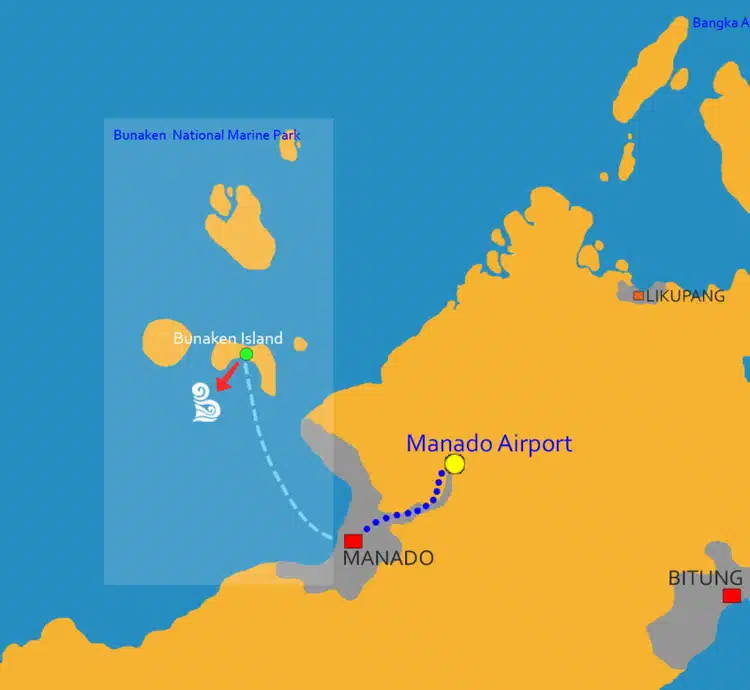
After arriving in Manado, the journey continues to Bunaken Island, where your stay at Bastianos Bunaken begins. From the airport, it’s about a 30-minute drive to the harbor, followed by a boat ride of about an hour to the resort. The boat transfer depends on the arrival time and weather and sea conditions.
If your flight arrives in Manado late on Day 2, it’s more practical to stay one night in Manado first and depart for Bunaken the next morning. The crossing to the island can then take place the following morning.
Once you arrive at Bastianos Bunaken Dive Resort, there will be time to check in and relax. After that, the diving program begins in Bunaken National Marine Park, which is known for its steep reef walls, colorful corals, and abundant reef life. During the dives, you may encounter sea turtles, schools of reef fish, and various types of coral and macro life.
Days 4–7 | Diving around Bunaken & Manado
During your stay in Bunaken, you’ll go on three boat dives every day. With nearly 40 different dive sites around the island, there’s plenty of variety and lots to discover. The dive sites are scattered along the coast of Bunaken and offer a variety of underwater landscapes.
Bunaken is part of the Bunaken National Marine Park, which consists of five islands. Around the islands, the seafloor drops rapidly to great depths, in some places exceeding 600 meters. The islands can actually be viewed as the peaks of an underwater mountain range. This creates the impressive steep walls for which Bunaken is famous.
The dive sites consist of steep drop-offs, sloping reefs, and shallow coral gardens. The walls are richly covered with hard and soft corals and sponges and provide a habitat for an enormous variety of reef fish. Schools of fusiliers swim along the wall, while butterflyfish, sweetlips, cardinalfish, and damselfish can be found among the coral.
Sea turtles are one of Bunaken’s major attractions. Both green sea turtles and hawksbill sea turtles are regularly spotted, often resting against the reef wall or swimming among the coral. Larger species such as tuna, barracuda, wahoo, humphead parrotfish, and reef sharks may also pass by during a dive.
There’s also plenty to discover for lovers of small marine life. Among the coral and along the walls live scorpionfish, lionfish, nudibranchs, shrimp, and seahorses, among others. A good dive guide can help you spot these well-camouflaged creatures.
Bunaken is suitable for divers of various skill levels. For those who want to dive deeper, the steep walls offer plenty of opportunities, though more diving experience is recommended. In shallower waters, you’ll see colorful coral gardens, often around four meters deep. This is a great spot for a safety stop and, at the same time, an excellent environment for snorkelers.
Day 8 | From Bunaken to Bangka Island
After the stay in Bunaken, the trip continues to Bastianos Bangka Dive Resort, located on Busa Bora Beach on Bangka Island. The resort is situated right on a white-sand beach and is surrounded by tropical nature. The peaceful setting and ocean views make Bangka a wonderful place to stay for a few days and relax between dives. The resort features an infinity pool, and right on the water is a private dock that also provides access to the house reef.
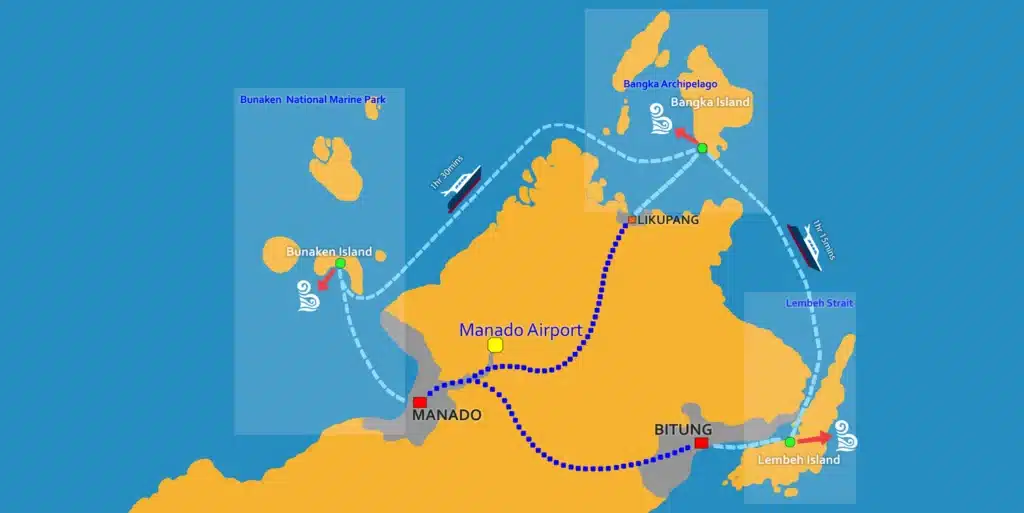
The best way to travel from Bunaken to Bangka is by boat. The crossing is combined with two dives along the way, turning the trip into a full day of diving. You’ll dive at two different sites along the way, and then the boat continues on to the resort on Bangka. You also won’t need to take a car: the boat docks right at the new resort.
If you get seasick easily, you can also opt for a transfer via the mainland. Part of the route is then traveled by car, which limits the time spent at sea. This transfer is an alternative for those who prefer to spend less time on a boat, but no dives are made along the way.
Once you arrive on Bangka, the next part of the dive safari begins. There are more than 40 dive sites around the Bangka Archipelago, featuring colorful soft and hard corals, underwater pinnacles, walls, caves, and sandy bays. The house reef at Bastianos Bangka is also a popular dive site and is well-suited for drift diving.
Days 9–12 | Diving near Bangka Island
Over the next few days, you’ll be diving around Bangka Island. The itinerary includes three boat dives each day, and with more than 40 dive sites around the Bangka Archipelago, there’s plenty of variety. In addition, Bastianos Bangka has a house reef that’s ideal for drift diving, among other things.
The dives around Bangka showcase a variety of underwater landscapes. You’ll find coral reefs with hard and soft corals, impressive underwater pinnacles, steep walls, and caves. In other areas, the dive sites consist of seagrass, sandy bottoms, or volcanic seabeds. As a result, the underwater landscape changes frequently, and so does the marine life you encounter.
The colorful reefs are home to large numbers of reef fish and other marine life. Among the corals, you can find butterflyfish, reef groupers, damselfish, and various species of nudibranchs, among others. Larger animals may also make an appearance. Dolphins and dugongs are sometimes spotted in the area; you’ll often see them at the surface while you’re on the boat. A fantastic surface interval!
In addition to reef diving, there are also opportunities for muck diving around Bangka. On the mainland, there are several dive sites with sandy bottoms where you can find other, often smaller and well-camouflaged creatures. These dive sites are about a 5- to 30-minute boat ride from the resort.
The combination of colorful coral reefs, walls, pinnacles, caves, and muck diving ensures that the dives around Bangka are quite varied. The local dive guides know the area well and know where to find the most interesting creatures at any given time.
Day 13 | From Bangka to Lembeh
After the stay on Bangka, the journey continues to Lembeh Island, the third and final destination of the Coral Triangle Dive Safari. The best way to make this transfer is, once again, by boat. The boat sails directly from Bastianos Bangka to Bastianos Froggies Lembeh, and two dives are made along the way. This means the transfer itself is also a day of diving, and you’ll discover new dive sites along the way.
There is also an alternative route via the mainland. This involves first taking a boat to the mainland, then traveling by car to the next port, and finally taking another boat to Lembeh. This option is for those who prefer to spend less time at sea, for example, if you’re prone to seasickness.
On Lembeh, you’ll stay at Bastianos Froggies Lembeh Dive Resort, located on the quiet west side of Lembeh Island, overlooking the Lembeh Strait. The resort is nestled among tropical greenery and offers various room types, including Superior Beachfront bungalows right on the water. There is a swimming pool with a pool bar, a restaurant and lounge bar, a marine life library, and, of course, its own dive center.
After arrival, there will be time to relax and explore the resort. The next few days will be entirely devoted to diving in the Lembeh Strait, one of the world’s most famous areas for muck diving and extraordinary macro life.
Days 14–16 | Diving in the Lembeh Strait
You’ll spend the final days of diving on this trip in the Lembeh Strait, the body of water between Lembeh Island and the port city of Bitung. This area is known worldwide as one of the best destinations for muck diving. The dark, volcanic sandy bottom provides a unique habitat for a vast array of marine life. During the dives, the focus is mainly on calmly searching the seabed and discovering unique creatures hiding among the sand, debris, and small pieces of coral.
Lembeh is known for its wide variety of macro life. With a little luck, you’ll encounter species that are rarely seen at other dive destinations, such as various types of anglerfish, octopuses, cuttlefish, nudibranchs, seahorses, and unusual shrimp. The conditions are also ideal for macro and super-macro photography. The current is generally mild, and most dive sites are relatively shallow, with an average depth of about 15 meters and a maximum of approximately 25 meters. Visibility is usually limited, but this actually works well for macro photography.
Although Lembeh is best known for muck diving, there are also shipwrecks and a few dive sites suitable for wide-angle photography. As a result, the variety within the Lembeh Strait is greater than its reputation as a macro paradise might suggest.
A special highlight of the dive program is the mandarin fish dive, which is organized once a week. This dive takes place around dusk, when the colorful mandarin fish become active and emerge from among the reef. These small fish are beautifully colored and can be easily observed during this special dive.
Days 18 & 19 | Back Home
After the final dives in the Lembeh Strait, the return trip to the Netherlands begins. From Lembeh, you’ll take a boat transfer to the mainland, after which you’ll continue by car to the Manado airport.
Upon arrival at the airport, you’ll board your flight to the Netherlands, with a layover along the way. Depending on your flight itinerary, you’ll arrive back in the Netherlands the following day.
This brings to a close a varied diving trip through three extraordinary areas of North Sulawesi. From the steep coral walls and sea turtles around Bunaken, through the colorful reefs of Bangka, to the extraordinary macro life of Lembeh: three completely different dive sites, all combined into one trip. Due to travel time and the time difference, you’ll arrive home the next day.
Highlights of this trip
What can you expect from the underwater world of North Sulawesi?
Bunaken National Park
Bunaken Marine Park is known for its crystal-clear waters and impressive steep reef walls that, in some places, drop to depths of over 600 meters. Along the walls, you’ll find colorful coral reefs, large schools of reef fish, and frequent sightings of green sea turtles and hawksbill sea turtles. Larger species can also be spotted. The combination of large marine life and small macro life makes Bunaken a fascinating destination for underwater photographers. Night dives and relaxing evenings on the beach are also part of the experience.
Bangka Archipelago
The Bangka Archipelago is one of the richest areas for soft corals in North Sulawesi. The current carries nutrient-rich water past the reefs, allowing soft corals of all colors to thrive. Schools of reef fish swim around the pinnacles and walls, and with a bit of luck, you might also spot reef sharks and eagle rays. The current provides excellent drift dives at various dive sites. At the same time, there is a wealth of macro life to be found, making Bangka a versatile destination for underwater photographers.
Lembeh Strait
The Lembeh Strait is world-renowned for its exceptional muck diving. On the dark volcanic sandy bottom, among pieces of coral, debris, and small crevices, live creatures you’re unlikely to encounter at many other destinations. With a good dive guide and at a leisurely pace, you can search for creatures such as mimic octopuses, flamboyant cuttlefish, rhinopias, and hairy anglerfish. Lembeh is all about careful observation and patience: it’s precisely the small, well-camouflaged creatures that make every dive a surprise.
Accommodations
The Resort and Surroundings
Bastianos Dive Resort, Bunaken Island
Bastianos Bunaken Dive Resort is located on Liang Beach, on the southern tip of Bunaken Island, in the heart of Bunaken National Marine Park. The resort is right on the beach and offers ocean views. Liang Beach is one of the longest sandy beaches on the island and offers a peaceful spot to relax after diving.
The property offers a variety of room types, ranging from Standard and Superior Hillside Rooms to Superior and Deluxe Beachfront Rooms. All rooms are air-conditioned. The beachfront rooms are located directly on the beach and feature a private terrace, while the hillside rooms are nestled among the greenery on the hillside.
The property also features a swimming pool, a restaurant, and a beach bar. Free Wi-Fi is available in the lobby and restaurant areas, and massages can be booked.
Of course, the resort has its own dive center run by Bastianos Divers. It features several dive boats, a special room for underwater cameras, and a drying room for diving gear.
Bastianos Dive Resort, Bangka Island
Bastianos Bangka Dive Resort is located on Busa Bora Beach, on the southwest coast of Bangka Island. The resort is situated directly on a white-sand beach and is surrounded by tropical nature. From the beach, you can look out over the sea, and at the end of the day, you can often enjoy a beautiful sunset.
There are several room types, including Standard Hillside, Superior Hillside, and Superior Beachfront. The Superior Hillside rooms are decorated in a traditional Indonesian style and are situated against the green hillside. The Beachfront bungalows are located directly on the beach and feature a private balcony with a view of the sea. All rooms are equipped with air conditioning and a private bathroom with hot water.
The resort features an infinity pool, a restaurant, and a poolside minibar. For those who want to learn more about marine life, there is a marine life library. Massages are also available. Free Wi-Fi is available around the lobby and the restaurant, and the resort has 24-hour electricity.
Of course, Bastianos Bangka has its own dive center, Bastianos Divers, with several dive boats, a separate camera room, and a drying room for diving gear. There’s also a house reef, which you can access directly from the beach. It’s a great spot for snorkeling, too!
Bastianos Froggies Lembeh Dive Resort
Bastianos Froggies Lembeh is located on Lembeh Island, on the Lembeh Strait and across from the port city of Bitung. The resort is nestled among tropical greenery and overlooks the calm waters of the strait.
There are three room types: Standard Hillside, Superior Hillside, and Superior Beachfront. The Standard Hillside rooms are located slightly higher up the hillside and are surrounded by tropical greenery. The Superior Hillside rooms are built in traditional Minahasa style and feature a private veranda with views of the Lembeh Strait or the lush surroundings. The Superior Beachfront rooms are located right on the water and have a private balcony overlooking the strait. All rooms are equipped with air conditioning and a private bathroom with a hot shower.
The resort features a swimming pool with a pool bar, a restaurant with a lounge bar, and a marine life library. Free Wi-Fi is available around the lobby and the restaurant. Guests can also book a traditional massage.
It also has its own dive center, with three dive boats, a separate camera room, and a drying room for diving gear. The camera room provides space to prepare and charge cameras and underwater housings. The dive boats are equipped with oxygen for first aid, and during dives, drinking water, coffee, tea, and—for morning dives—snacks and fruit are available. There is also a house reef.
Travel Expenses
What's Included
This travel package costs US$ 5.197 per person, based on two people sharing a room. The trip can be extended as desired. A number of items are included as standard in this travel package.
Prices are subject to change due to price adjustments, increases, or fluctuations in exchange rates. Flights are always booked in the lowest available fare class.
Want to learn more about the options? Contact us!
Included in this trip, from US$ 5.197 p.p.
- 15 nights in a Superior Beachfront Room
- Stay on a full-board basis
- Coffee, tea, mineral water
- Diving package with 41 dives
- All transfers listed
- VZR, Emergency Fund & Administrative Fees
Excluding
- Flight to Manado from US$ 1.230 p.p.
- Hotel stay on days 1–2
- Bunaken Marine Park Fee 150,000 IDR (one-time) approx. ±US$ 10 p.p.
✈︎ The quoted (international) flight prices are indicative prices and based on departures from Europe. However, we can arrange flights from any location worldwide. Booking your own flights is of course also possible.
Optional
- Rent a complete set of diving equipment (US$ 28 s per day)
- Dive computer rental (US$ 11 per day)
- Nitrox (US$ 11 per tank)
- 13L tank (US$ 11 per tank)
- Exchange a day dive for a night dive or a mandarin fish dive (US$ 17 extra)
- Night Dive (US$ 87 per dive)
- Mandarin fish dive in Lembeh (US$ 87 s per dive)
Prices vary by resort and dive center. Check the FAQ at the bottom of the page for all prices for optional activities and components.
Send this trip by email
Want to save or share the details of this trip with someone? You can do so by sending the trip by email.
Where may we send the email to?
Frequently Asked Questions About This Diving Trip
General Information About Diving
Currents are usually mild and sometimes strong. There are plenty of dive sites suitable for beginner divers. You can take this trip with an Open Water certification.
However, there are many macro and muck diving sites, so it’s important to have good buoyancy control to truly enjoy the dives.
Yes, valid diving insurance is required to dive with Bastianos. Any diving insurance policy that provides coverage for diving accidents and diving-related medical expenses is acceptable.
Short-term DAN insurance can also be purchased during your stay and takes effect immediately. This short-term coverage is valid only within Indonesia. Annual insurance provides worldwide coverage.
You’ll be diving in 3 different areas, so there will be plenty of variety in the types of dives you’ll do. In Bunaken and Bangka, the maximum dive time is 70 minutes. In Lembeh, you’ll spend most of your time searching for small critters. There’s no maximum dive time here, but the dive ends when you reach 50 bar.
All the dive sites are within a 30-minute boat ride.
The standard diving schedule consists of up to four dives per day. The package includes 3 dives as standard.
• 8:00 a.m.: two morning dives, with a one-hour surface interval between dives.
• 3:00 p.m.: one afternoon dive.
• 5:30 – 6:00 p.m.: a night dive or mandarin fish dive.
The exact schedule may vary from day to day, depending on diving conditions and the planned dive.
You can go night diving here. An additional night dive costs US$ 87. You can also upgrade a regular day dive to a night dive (or a mandarin fish dive). This costs US$ 17.
A mandarin fish dive is a special dive focused on finding the colorful mandarin fish. These small reef fish are most active around dusk, when they’re easy to spot. The dive takes place at a special dive site in Lembeh and is organized every Thursday. The cost for this dive is US$ 87. You can also upgrade a regular day dive to a mandarin fish dive. This costs US$ 17.
The resorts in Bangka and Lembeh have a house reef. There is no house reef in Bunaken.
Yes, you can take PADI courses at all three locations.
Yes indeed, on the same property.
Diving equipment
Both tanks are available.
As is the case in most places in Indonesia, divers use aluminum tanks. The standard tanks are 80 cu ft, approximately 11 L. The large tanks are 100 cu ft, approximately 13 L. This is the largest tank size available. The cost is US$ 11 per tank.
A small number of larger tanks are available. Unfortunately, it is not possible to reserve these in advance.
No, there are no options for this.
Nitrox is available, but must be requested in advance. Information about nitrox is required for both gas planning and dive organization. When organizing dive groups, factors such as experience level and whether divers will be using air or nitrox are taken into account.
If nitrox is not requested in advance, it will be assumed that the dive will be conducted using air. In that case, the availability of nitrox cannot be guaranteed upon arrival at the resort. The cost for nitrox is US$ 11 per tank.
Yes, you can rent diving equipment here. A full set costs Nitrox US$ 28 per day. A dive computer costs US$ 11 per day.
Related Diving Trips


Round trip North Sulawesi – Bunaken, Bangka & Lembeh
Stay at 3 sites in North Sulawesi: at Lumbalumba Resort, Sea Souls Dive Resort and Pulisan Resort. You will make...
Want to read more about this destination?

12 unusual critters you see while diving in Lembeh Strait
In Lembeh you can see critters you may not even know existed. Check out what you may encounter while diving in this special area.
We are EWDR